
Are Recycled Umbrella Claims Ready for New EU Rules?
Why the September deadline matters
The European Commission says rules introduced through Directive (EU) 2024/825 will apply from 27 September 2026. They prohibit vague environmental statements such as “green” or “environmentally friendly” when a company cannot demonstrate the claim. The same rules also restrict unreliable voluntary sustainability labels.
Textile Exchange has aligned its current Standards Claims Policy with this changing environment. Its updated policy becomes mandatory on the same date. For umbrella buyers, this is a practical prompt to review hangtags, catalog copy, ecommerce descriptions and sales presentations before placing a repeat order.
Name the component before asking for a price
An umbrella is a mixed-material product. The canopy may be polyester, while the ribs use fiberglass or metal and the handle uses plastic, rubber or wood. A pouch may match the canopy fabric, but that should not be assumed.
This makes recycled umbrella sourcing easier to quote. A supplier can check fabric availability, certification scope, color range and minimum quantity against a defined canopy specification. A request for a “fully recycled umbrella” is harder to interpret because it may also appear to cover the frame, mechanism, handle, sewing thread and packaging.

Understand what RCS and GRS verify
The Recycled Claim Standard and Global Recycled Standard are both voluntary third-party systems for recycled materials and chain of custody.
A product can use GRS as a business-to-business tool from 20% recycled content, according to Textile Exchange. Consumer-facing GRS labeling requires at least 50%.
Certification answers a defined question. It can verify recycled content and custody under the applicable standard. It does not automatically prove that an umbrella is more durable, more waterproof or lower in carbon emissions than another model.
What each record proves
|
Record |
What it supports |
What it does not prove |
Buyer check |
|
Scope certificate |
Company is qualified within its listed scope |
Every shipment is certified |
Name, site, scope, standard and validity |
|
Transaction certificate |
Specific certified products moved through the chain |
Product performance |
Order description, quantity and trading parties |
|
Material specification |
Approved fabric and claimed component |
Chain of custody |
Fiber, percentage, weight, finish and material code |
|
Approved claim artwork |
Permitted wording and label presentation |
Delivered goods match |
Scope, percentage, license details and approval |
|
Production sample |
Construction, appearance and label position |
Certified content by itself |
Model match, fabric code, performance and labeling |
Trace the material through the actual order
Before approving bulk production, map the route from yarn or fabric supplier to dyeing, finishing and umbrella assembly. Confirm which companies need certification and who will request the transaction documents. Names, addresses, material descriptions and quantities should match the purchase order rather than resemble it only in general terms.
Timing matters. If a fabric is booked before the documentation route is agreed, a buyer may receive the right color and construction without the evidence needed for the intended claim. Put document responsibility and delivery timing into the order plan while the material is still being selected.

Keep the specification aligned with the evidence
A recycled-content program still needs an ordinary product specification. Record canopy fiber, fabric weight, weave, color target, coating or finish, print method and seam construction.
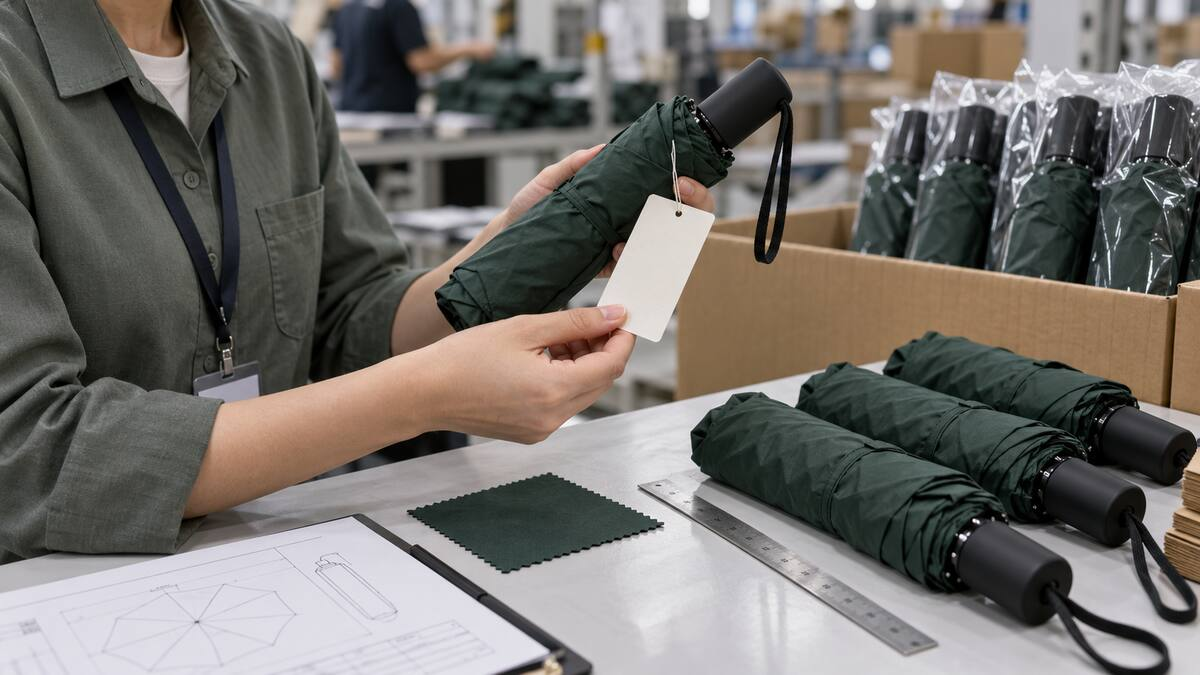
Do not let an approved green swatch stand in for the complete specification. The same shade can be produced on fabrics with different weights, coatings and certification status. Mark the approved sample with a date and material code, then link it to the bill of materials and purchase order.
Test performance as a separate workstream
Recycled content does not determine how well the umbrella opens, resists rain or holds its color. Approve the fabric and certification path, then run the product checks required for the chosen market and price level. These may include water resistance, color fastness, print adhesion, opening cycles and frame inspection.
Compare the production-representative sample with the conventional version if the program is replacing an existing umbrella. Look for changes in hand feel, folding bulk, shade, coating behavior and print result. Decide acceptance limits before production so the environmental claim does not distract from normal quality control.
Separate product packaging from the umbrella claim
An umbrella and its packaging can carry different recycled-content statements. If the paper box contains recycled fiber, say so on the box and keep that evidence with the packaging file. Do not let a packaging statement appear to describe the umbrella canopy or the whole product.
Send a claim ready inquiry
A useful request for quotation states the umbrella format, quantity, destination market, claimed component, recycled percentage, preferred standard and planned consumer wording. It also names the certificates and order records the buyer expects, the testing plan, label approval route and required delivery date.
The VESTA umbrella collection gives buyers several frame formats to develop, including a 23-inch automatic folding umbrella and larger golf-umbrella options. Canopy material, certification availability, minimum quantity and claim eligibility must be confirmed for the selected supply chain and production lot.
Handled this way, recycled umbrella sourcing becomes a controlled product-development project instead of a last-minute marketing request. The sample shows how the product looks and performs; the document file shows what the buyer may accurately say about it.
Frequently asked questions
Does GRS certification mean the entire umbrella is recycled
No. The claim must identify the certified material and the percentage covered by the evidence. A certified recycled canopy does not automatically make the frame, handle, strap or packaging recycled.
What is the practical difference between RCS and GRS
Both verify recycled content and chain of custody. GRS also adds processing requirements for social, environmental and chemical practices and uses a higher recycled-content threshold for consumer-facing labeling. Confirm the current rules with the certification body.
What should be included in a recycled umbrella RFQ
State the umbrella model, claimed component, recycled percentage, preferred standard, destination market, intended claim, quantity, color, tests, certification documents, label approval route and target schedule.