

Which Custom Umbrella Packaging Works Best for Buyers?
Start with the route to the customer
The same umbrella can need very different packaging depending on where it is sold. A corporate gift may be handed directly to an employee. A department-store item needs to sit neatly on a shelf and scan at checkout. An online order may travel alone through a parcel network. Choosing the package before deciding the sales route usually creates extra cost or leaves the product under-protectedWrite down who opens each layer. The consumer may remove a fabric sleeve, while warehouse staff handle an inner box, export carton and pallet. Each layer has a separate job. The consumer pack supports presentation and product information; the shipping pack controls movement, compression and handling through distribution.
Measure the closed umbrella before designing the pack
Custom umbrella packaging starts with the finished product, not a nominal frame size. Measure the approved sample after the canopy has been folded normally and the strap is closed. Record the maximum closed length, handle width, shaft thickness and the bulkiest part of the folded canopy. A ten-rib compact umbrella may need more room than an eight-rib version even when the advertised canopy size looks similar.
Allow enough clearance for packing without forcing the frame, but avoid a loose package that lets the umbrella slide. A snug paper sleeve can crease when the canopy varies slightly between units. An oversized retail box adds freight volume and may let the handle strike the ends. Sample the package around production-representative umbrellas, then confirm the inside dimensions rather than relying only on a drawing.

Packaging should be selected around the finished umbrella and the intended sales channel rather than around appearance alone.
Choose the lightest format that does the required job
A matching fabric sleeve is familiar and reusable, but it offers little crush protection. It works well for many promotional and travel umbrellas when the units remain inside a strong master carton. A paper belly band can hold a barcode and brief product details without covering the entire item, provided it stays secure during handling.
Retail cartons give more space for instructions, brand artwork and hanging or shelf display. They also add print setup, assembly time and shipping volume. A premium gift box may suit a presentation set, but the box should earn its place in the project. Heavy packaging used for a short event handout can consume budget that would be better spent on the umbrella itself.
A protective bag may be requested to keep dust or moisture off the retail unit. The buyer should specify material, thickness, sealing method, warning text and destination-market requirements instead of writing only “polybag.” Where plastic is unnecessary, a fitted sleeve or paper-based restraint may be easier for the customer to handle.
Common packaging formats compared
|
Format |
Typical use |
Main advantage |
Point to confirm |
|
Fabric sleeve |
Everyday storage and promotional distribution |
Reusable and compact |
Little crush protection |
|
Paper belly band |
Minimal retail information or gift programs |
Low material use and easy branding |
Needs accurate fit and secure closure |
|
Retail carton |
Shelf display and store distribution |
More space for graphics and instructions |
Adds assembly time and freight volume |
|
Gift box |
Premium sets and presentation programs |
Strong presentation and product restraint |
Higher cost and usually larger pack |
|
Parcel shipper |
Direct-to-consumer delivery |
Designed around the delivery route |
Requires route-specific testing and approval |
Protect the parts that mark easily
Handles, ferrules and coated shafts often show packing damage before the canopy does. A glossy handle can rub against the next unit; a wooden handle can pick up dents; a long golf-umbrella tip can puncture a light carton. Small caps, tissue wraps, dividers or correctly positioned inner boxes can solve these specific problems without wrapping the whole umbrella in several unnecessary layers.
Check how the strap, pouch and printed panels sit after packing. The package should not hold transfer film against a sharp fold or press a buckle into printed fabric. Open several packed samples after a short storage period. Freshly packed units can look fine while pressure marks, ink transfer or bent tags appear later.
Design retail information around real scanning
Retail artwork needs a final list of required information before printing. Depending on the market and channel, that may include product identity, importer details, country of origin, fiber content, warnings, care instructions and a barcode. The importer should confirm the legal wording.
Print the barcode at its intended size and scan the physical sample before approving the packaging run. Test the unit in its final shape, not only a flat proof. A label that scans on a sheet may wrinkle around a sleeve or sit beneath a cord. Check the consumer unit and the outer carton separately because they may use different identifiers.
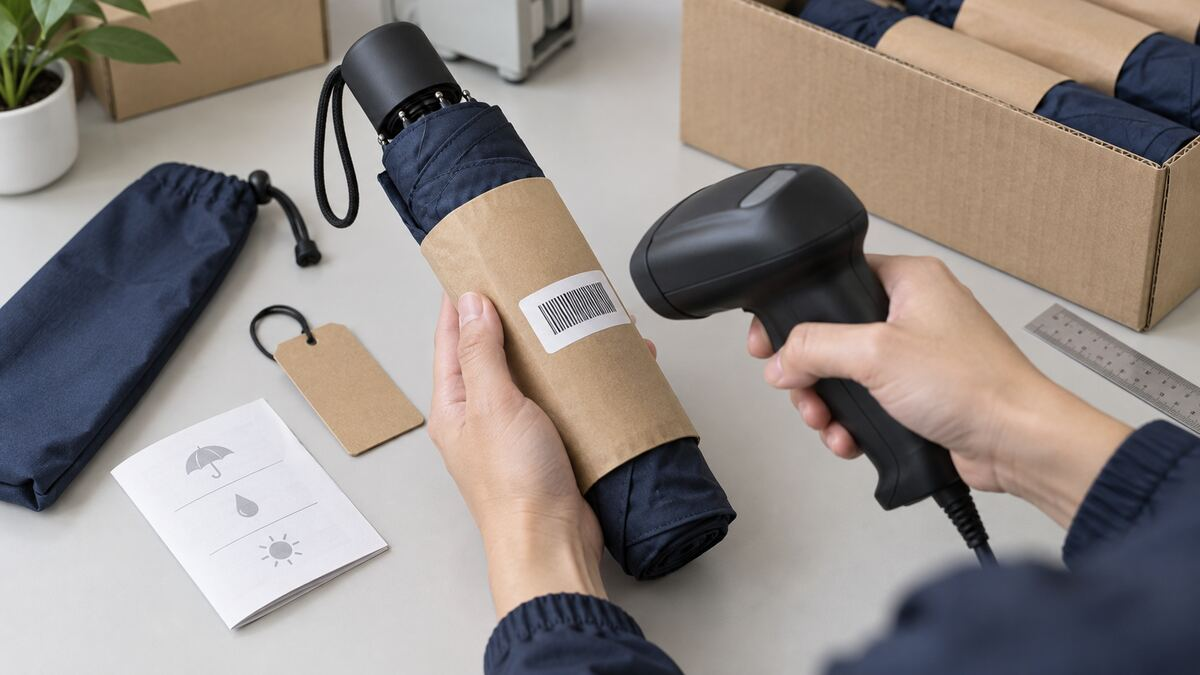
Scan the barcode on the finished package at its approved size and position before bulk packaging is printed.
Treat the master carton as a measured system
The export carton specification should state units per carton, assortment, internal layout, board construction, closure method, outside dimensions and target gross weight. Those details influence freight calculations and warehouse handling. A carton packed with compact umbrellas behaves differently from a long carton of straight or golf umbrellas, even when both contain the same number of pieces.
Pack orientation matters. Alternating handles can reduce empty space, but the arrangement must remain simple enough for repeat production and customer counting. Dividers may prevent rubbing, while excessive void fill can shift or collapse. Build a trial carton with the final consumer packages and record the packing sequence with photographs.
Carton markings should match the purchase order and destination instructions. Confirm model, color, quantity, carton number, gross and net weight, dimensions and any handling symbols required by the buyer. If mixed colors are allowed, show the assortment on the packing list and carton mark so a warehouse can identify the contents without opening every box.
Approve a packed sample instead of separate components
A color proof can approve graphics, but it cannot show whether the umbrella fits, the carton closes cleanly or the tag rubs the handle. Ask for a complete packed sample using the intended materials. Review it in the same order a customer will: shipping carton, retail pack, sleeve and umbrella.
Record each approved component with a version date. Include the dieline, artwork, label file, dimensions, board or film specification, closure and packing sequence.
Send a complete packaging brief with the inquiry
A useful inquiry states the umbrella model, order quantity, sales channel, destination, consumer-pack format, retail information, barcode requirement, master-carton limit and any test protocol. Attach the approved artwork or an example dieline when available. If the retailer has a vendor manual, send the relevant pages at the quotation stage.
The VESTA umbrella collection includes compact, straight and large-canopy models that need different packs. The 23-inch automatic folding umbrella can use a compact retail format, while a custom printed golf umbrella needs a longer carton and more attention to handle and tip protection. Final packaging should always be sampled around the selected product configuration.
Clear custom umbrella packaging requirements reduce revisions because the supplier can quote the real materials and packout from the beginning. The approved sample then gives production one repeatable reference for the unit pack, carton assortment and markings. That is more useful than choosing a box from a photograph after the umbrellas are already finished.

A trial carton should use the final unit packages and record the arrangement, quantity and markings before bulk packing begins.
Frequently asked questions
Is a fabric sleeve enough for a custom umbrella order
It can be enough for promotional distribution or wholesale cartons when the master carton protects the units. Retail shelves and individual parcel delivery may require extra structure, labels or a separate shipping package.
When should buyers approve umbrella packaging
Approve the complete packed sample before bulk packaging is printed. Check the fit, opening sequence, barcode, labels, carton quantity and markings using the intended materials.
Should the consumer unit and export carton use the same barcode
Not necessarily. Consumer units, cases and other packaging levels may need different identifiers according to the buyer’s system and trading-partner rules. Confirm the data before artwork approval and scan both finished levels.
Does an e-commerce umbrella need a drop test
The buyer should select a test that matches the package and distribution route. Parcel, retail fulfilment and palletized wholesale shipments face different handling, so one generic drop test is not a universal answer.