
Which Beach Umbrella Materials Should Buyers Choose?
Two beach umbrellas can look almost identical in a catalogue and behave very differently after a season by the sea. The difference often sits in details that a photograph cannot show: the canopy's dyeing method, the pole's wall thickness, the rib profile and the small joints holding everything together.
For buyers comparing beach umbrella materials, the useful question is not simply which material is best. It is which combination suits the intended use, the target price and the way the umbrella will be maintained. A lightweight retail product and a rental umbrella opened every morning need different specifications.
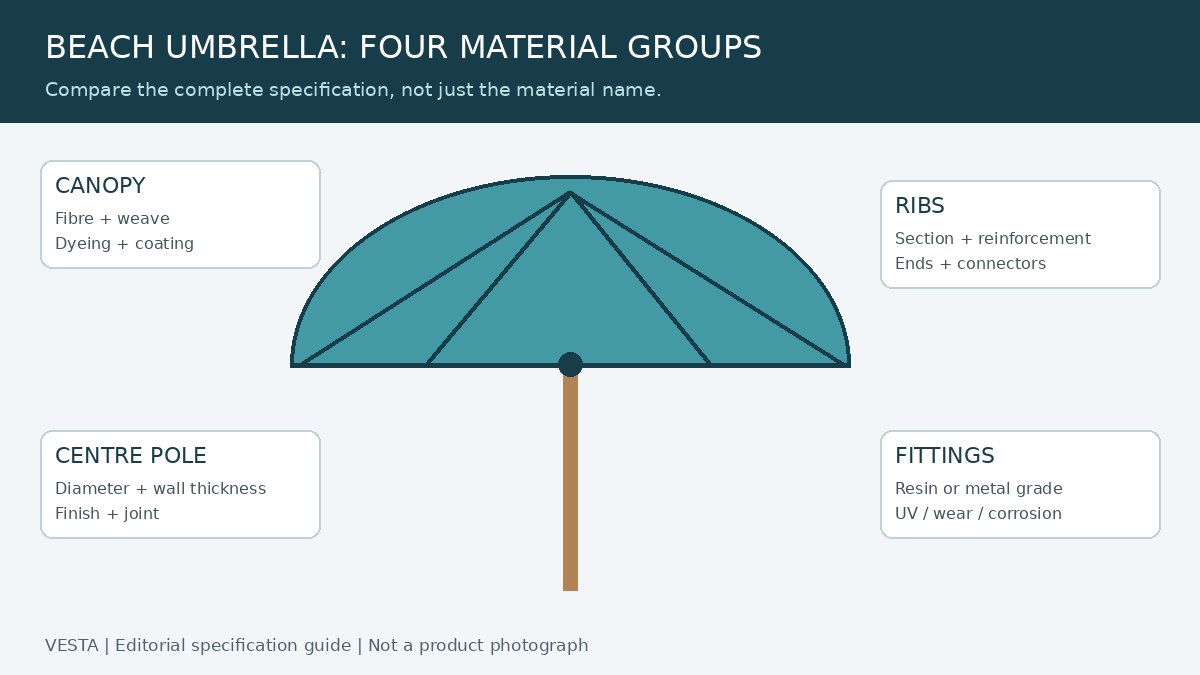
Material selection starts with four connected groups: canopy, pole, ribs and fittings. This is an editorial diagram, not a photograph of a specific product.
Canopy fabrics: separate the fibre from the finish
Polyester is a common starting point for price-sensitive beach products. It offers broad printing options and can be supplied in different weights and constructions. However, a fabric described only as “polyester” leaves too much unanswered. Ask for its weight in grams per square metre, dyeing method, finish and relevant test results.
| Fabric option | Why buyers consider it | What needs checking | Typical budget position* |
|---|---|---|---|
| Conventional dyed or printed polyester | Accessible starting cost and flexible artwork | Colourfastness, tear strength, coating and fabric weight | Entry to middle |
| Solution-dyed polyester | A colourfastness upgrade within the polyester family | Actual grade, colour availability and exposure test results | Middle to upper |
| Olefin / polypropylene fabric | An outdoor shade option where stock colours suit the project | Printing compatibility, weave and weathering evidence | Middle; varies by supplier |
| Solution-dyed acrylic | Often specified for premium outdoor shade and lasting colour | Exact fabric range, weight, care and warranty scope | Upper; branded grades can cost more |
| Cotton canvas or blended canvas | A textured appearance for selected leisure designs | Fibre composition, drying, shrinkage and mildew care | Variable; not necessarily cheaper |
*Budget positions are qualitative purchasing guidance, not market prices. Different weights, brands, finishes and order quantities can change the order.
Solution dyeing introduces colour during fibre manufacture rather than relying only on colouring a finished textile. It is worth considering when fading would make the product unacceptable. It does not, by itself, establish tear strength, water resistance or a guaranteed service life.
“Oxford” describes a fabric construction, not a separate fibre. A polyester Oxford canopy is still polyester. Similarly, “canvas” does not reliably identify the fibre content. Request the composition rather than making a purchasing decision from the trade name.
What do PU, silver and other coatings change?
A PU coating can add water resistance, while silver-coloured or other backing treatments may be specified for light blocking or UV performance. A water-repellent finish affects surface wetting. These are different functions, and the finished fabric needs to be tested for the function being claimed.
A heavier coating is not automatically an improvement. Ask whether the sample remains flexible after repeated folding and whether the finish changes its weight, feel or printing behaviour. Water resistance in a fabric sample also does not prove that seams or the assembled canopy are waterproof.
For UV claims, confirm the test method and its scope in the target market. ARPANSA distinguishes shade-fabric testing under AS 4174 from clothing UPF classification under AS 4399. A canopy rating should not be presented as complete protection for a person beneath it; shade coverage and reflected sunlight still matter.
Centre poles: steel, aluminium or wood?
A steel pole is often a practical choice when purchase cost matters more than carrying weight. Its trade-off is corrosion management. Request the coating system and inspect cut ends, joints and areas where repeated assembly may damage the finish. “Powder coated” is a process description, not a promise that rust cannot occur.
Aluminium is attractive for portable products because it can reduce weight. It still needs a suitable alloy, tube size, wall thickness and finish. A thin aluminium tube should not be treated as equivalent to a heavier engineered section simply because both quotations say aluminium.
Wood provides a different look and is used in some commercial beach designs. Ash and other specified woods need controlled grading, moisture and finishing. Confirm the species, joint construction and care instructions. Wood does not rust, but that does not mean it needs no maintenance.
| Pole | Main trade-off | Cost drivers to specify |
|---|---|---|
| Coated steel | Often lower starting cost; heavier, with exposed surfaces vulnerable to corrosion | Diameter, wall thickness, coating preparation and joint design |
| Aluminium | Lower weight; strength and coastal performance depend on the complete specification | Alloy, tube section, wall thickness, anodising or coating |
| Wood | Distinctive presentation; grading and maintenance matter | Species, diameter, moisture control, finish and hardware |
The pole also has to match the anchor or base. Check the actual diameter, insertion depth and locking arrangement before approving the sample. A material upgrade cannot compensate for an incompatible support system.
Ribs: flexibility is useful, but construction still matters
Steel ribs offer a familiar, often economical construction. Section shape, thickness, coating and connection quality determine how they behave. Damage to the finish can expose steel to corrosion, particularly where parts rub together.
Fibreglass ribs are used in beach and outdoor umbrellas because they can flex under load and avoid rust in the rib itself. They are composites, so diameter, reinforcement, resin and end fittings matter. They are not unbreakable, and metal connectors elsewhere in the frame still need protection.
Aluminium ribs can help control weight and suit certain frame designs. Buyers should compare the section and joints, not just the material name. Ask whether a damaged rib can be replaced individually and whether the canopy can be removed without replacing the entire umbrella.
No rib material makes an umbrella windproof.
Small parts deserve their own specification
When comparing beach umbrella materials, buyers often focus on the visible canopy and pole. Yet the runner, hub, tilt joint and locking button are touched every time the umbrella opens. A low-cost fitting can become the part that ends an otherwise usable product's life.
- PP or ABS moulded parts: possible choices for caps, handles and housings. Specify an outdoor-suitable grade, UV stabilisation and the required impact performance.
- Nylon / PA parts: used where the design calls for stronger engineering-plastic fittings. Moisture response, reinforcement and tolerances need checking; nylon is not automatically the correct choice for every joint.
- POM / acetal parts: an option for selected sliding or precision mechanisms. Confirm the suitability of the actual grade for exposure, wear and load.
- Metal fittings: tilt housings, rivets, pins and fasteners may use coated steel, aluminium, zinc alloy or specified stainless steel. Identify the material and finish of each critical part.
- Soft components: polyester sewing thread, webbing, rubber or TPE grips and protective caps need their own abrasion, weathering and compatibility requirements.
Stainless steel is not a single specification. Where salt exposure is relevant, ask whether fasteners are 304, 316 or another grade and why that grade was selected. Grade 316 generally offers better chloride resistance than 304, but it is not immune to corrosion. Dissimilar-metal contacts also need attention.
For plastic parts, request the resin grade, reinforcement and weathering evidence instead of accepting “high-quality plastic.” The shape and moulding quality still matter. Replacement runners, rib ends and locking parts can be worth more to a rental operator than a decorative upgrade.
How much do the materials cost?
| Component | Often the lower-cost starting option | What can add cost |
|---|---|---|
| Pole | Standard coated steel tube | Aluminium specification, thicker sections, selected hardwood, more durable finishes |
| Ribs | Standard steel construction | Engineered fibreglass or aluminium profiles, larger sections, replaceable end connections |
| Moulded fittings | Simple stock mouldings | Specified engineering resins, reinforcement, outdoor stabilisation, new tooling |
| Fasteners and joints | Standard coated hardware | Specified stainless grades, isolation between metals, serviceable joint designs |
These are starting comparisons, not a fixed price ranking. A well-specified steel assembly may cost more than a lightly built aluminium one. Small plastic parts can have modest recurring material costs but substantial tooling costs when a new shape is required.
There is no reliable universal dollar price for “a polyester canopy” or “an aluminium pole.” A useful quotation fixes canopy size, fabric consumption, fabric weight, pole dimensions, rib count, finish, artwork, quantity and delivery terms. Otherwise, apparent savings may simply reflect a smaller or lighter specification.
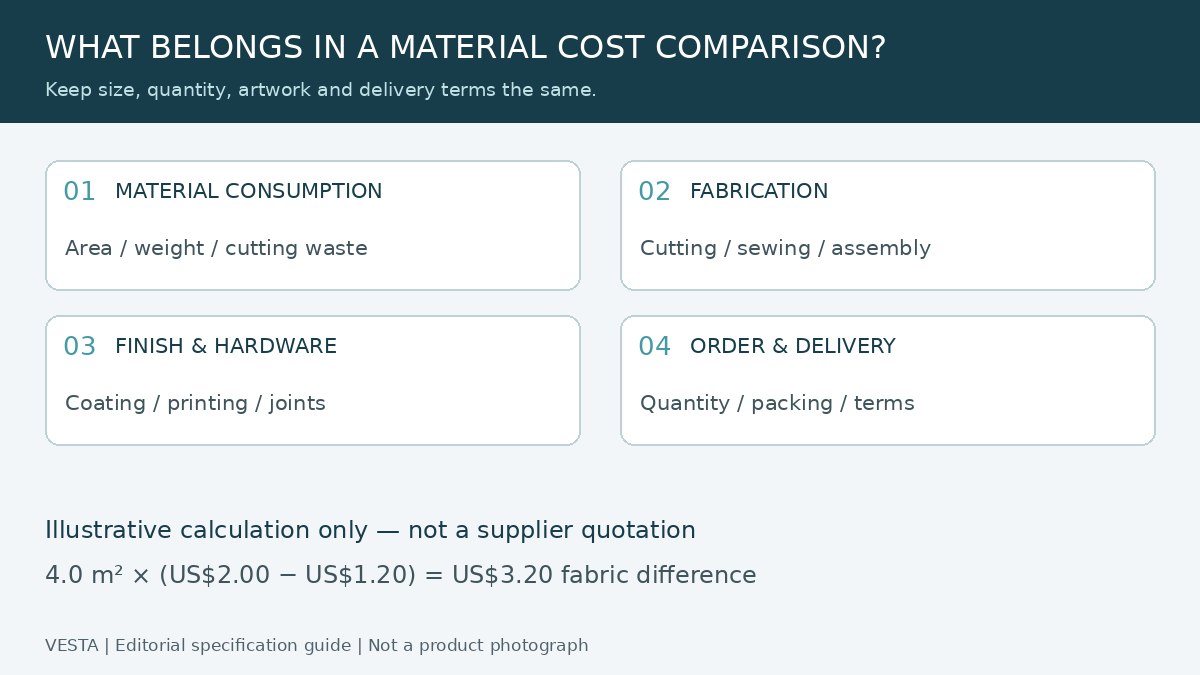
Compare a fixed specification first. A raw-material price is only one part of the finished umbrella quotation.
For a canopy, start with consumed fabric area multiplied by the supplier's price per square metre. Include cutting waste once, then add printing, sewing and finishing. For a pole, compare the complete finished part, including joints and surface treatment, rather than the metal's price per kilogram.
Here is a calculation example, not a current market quotation. Assume one canopy consumes 4.0 m² of fabric including cutting waste. If Fabric A is quoted at US$1.20/m² and Fabric B at US$2.00/m², the fabric-only difference is US$3.20 per umbrella. Printing, sewing, testing, freight and taxes are excluded.
Across 1,000 umbrellas, that assumed change adds US$3,200 before other differences. Ask the supplier to quote both versions against the same specification. Keep sampling, tooling and laboratory costs separate from recurring unit cost, especially on smaller orders.
For repeated commercial use, compare cost per usable season as well as purchase price.
Three combinations worth asking suppliers to quote
Budget-led retail: printed polyester, a coated steel pole and steel ribs can form a starting specification. Check packed weight, finish quality and the opening mechanism carefully. The lowest quote should still meet the agreed product and safety requirements.
Portable leisure: a suitable polyester or olefin canopy, aluminium pole and fibreglass ribs can be considered when carrying weight matters. Ask for the complete packed weight with the bag and anchor; accessories can change the comparison.
Resort or rental use: consider a verified colourfast canopy, an appropriately engineered wood or aluminium pole and serviceable ribs and fittings. Replacement parts, care instructions and repeat-order consistency belong in the purchase discussion from the start.
What to send with a material enquiry
Send the open diameter, intended use, expected opening frequency, target market, artwork and order quantity. Then request a component list identifying fabric composition and finish, pole dimensions, rib specification and critical fitting grades. Ask for the relevant reports and a sample built to that exact list.
VESTA's beach umbrella collection provides a starting point for configuration discussions. Its 7.5FT ash-wood pole model, for example, lists a polyester reference canopy and fibreglass ribs; the final fabric weight and coating still need confirmation.
The right beach umbrella materials are the ones that meet the intended use at an acceptable total cost. Ask for the details hidden behind the material names, compare like-for-like samples and agree which parts can be serviced. That makes the final quotation much easier to judge.