

What Should Buyers Check in a Custom Umbrella Quote?
Start by checking whether the products are actually the same
A price comparison is useful only when the product definitions match. “23-inch folding umbrella” does not identify the rib count, open diameter, closed length, frame combination, operating mechanism or handle. It also says nothing about fabric weight, coating or sewing details. A few unwritten choices can move the price more than a buyer expects.
Ask each supplier to return the custom umbrella quote against the same dated specification sheet. If a factory proposes an alternative, it should be marked beside the affected item instead of being buried in a general note.

Write the construction in terms that can be verified
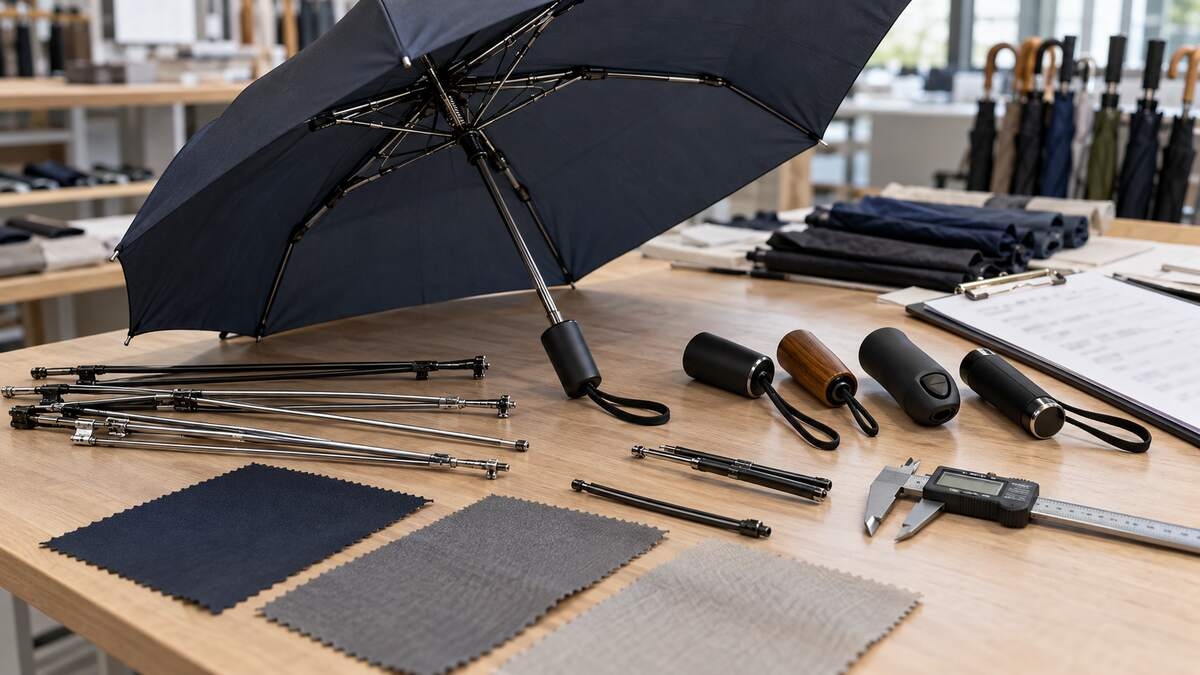
For the canopy, record the fiber, weave or fabric type, weight or other agreed construction, color method, coating and water-repellent finish where required. For the frame, identify the shaft, ribs, stretchers, tips and mechanism.
Dimensions need a measuring method. A nominal rib length is not the same as the open arc or the straight-line canopy diameter. Closed length and unit weight also matter because they affect retail fit and shipping. For automatic models, state whether the operation is auto-open or auto-open-and-close.
Handle material, finish, strap, pouch and tip should appear in the same specification. These parts are easy to overlook when buyers focus on the canopy, yet a molded handle, painted handle and wood-look handle can require different tooling, finishing and packing.
Read quantity breaks together with color and design splits
The quoted quantity may be the total order, while the production minimum applies to each canopy color, print design or handle option. A 3,000-piece order divided among six colors is not always priced like one 3,000-piece solid-color run. Smaller splits can increase material loss, setup time and packing work.
Request price breaks at quantities that reflect the buying plan rather than round numbers chosen for convenience. If a buyer expects a first order of 1,200 pieces and a possible reorder of 3,000, those are more useful tiers than 5,000 and 10,000. Ask how long the price remains valid and whether the same conditions will apply to a reorder.
The minimum information needed for a fair comparison
Quote area
What should be written
Why it changes the comparison
Buyer record
Product specification
Model, dimensions, fabric, frame, mechanism and accessories
Prevents cheaper substitutes from looking equivalent
Attach one dated revision
Quantity structure
Total quantity plus minimum per color or design
Small splits can change setup and material cost
Quote realistic order tiers
Printing scope
Method, colors, panel positions and artwork size
“Logo included” is not a defined print job
Use the approved artwork version
Additional charges
Samples, setup, tools, tests, inspection and courier
Separates first-order cost from repeat cost
Mark credits and refund conditions
Delivery basis
Named place and Incoterms® 2020 rule
Shows which logistics costs and risks are covered
Repeat exact wording on the order
Commercial timing
Price validity, start point, production and payment terms
Exposes schedule and currency assumptions
Record dates and approval triggers
Separate one-time charges from the unit price
|
Quote area |
What should be written |
Why it changes the comparison |
Buyer record |
|
Product specification |
Model, dimensions, fabric, frame, mechanism and accessories |
Prevents cheaper substitutes from looking equivalent |
Attach one dated revision |
|
Quantity structure |
Total quantity plus minimum per color or design |
Small splits can change setup and material cost |
Quote realistic order tiers |
|
Printing scope |
Method, colors, panel positions and artwork size |
“Logo included” is not a defined print job |
Use the approved artwork version |
|
Additional charges |
Samples, setup, tools, tests, inspection and courier |
Separates first-order cost from repeat cost |
Mark credits and refund conditions |
|
Delivery basis |
Named place and Incoterms® 2020 rule |
Shows which logistics costs and risks are covered |
Repeat exact wording on the order |
|
Commercial timing |
Price validity, start point, production and payment terms |
Exposes schedule and currency assumptions |
Record dates and approval triggers |
A low unit price can sit beside several project charges. Common examples include sample making, printing screens, color separation, molds, tooling, artwork adjustment, testing and courier fees. None is automatically unreasonable, but they should be visible so the buyer can compare the first order and repeat orders correctly.
Ask which charges are refundable or credited after a production order, and under what condition. A sample fee may be credited only after a minimum quantity is placed. A printing screen may be reused for the same artwork, but a changed logo size can require a new screen.
Describe printing by method position color and coverage
“Logo included” leaves too much open. The cost depends on the print method, number of panels, number of colors, artwork size, ink coverage and whether the image is printed before or after panel cutting. A one-color mark on one panel is a different job from a full-canopy repeat pattern.
Give the supplier the final vector file or a clearly labeled draft. Ask the quotation to state the maximum quoted print area and the number of print positions. If the price is based on a temporary placeholder, require a revised price after production artwork is approved.
Color matching can carry its own sampling work. Note whether the quote includes a digital proof, printed strike-off or complete pre-production sample. A paper proof confirms layout; it does not show ink opacity, fabric texture or the way adjoining panels meet on an open umbrella.
Put samples tests and inspection on named lines
The sample section should identify what will be supplied and when. A stock sample can show size and mechanism, but it may not confirm the selected canopy, color, logo or package. A pre-production sample should match the intended order closely enough to serve as the approval reference.
Testing costs depend on the market, product claims, laboratory and number of materials or colors. Ask the supplier to quote only the methods required for the project and to state whether reports, sample preparation and courier charges are included.
The same applies to inspection. State whether the price includes the supplier’s internal checks only or whether a third-party inspection is planned. If an external inspection is buyer-paid, reserve time for it in the production schedule and agree who pays for reinspection after a failed result.
Check packaging dimensions before estimating freight
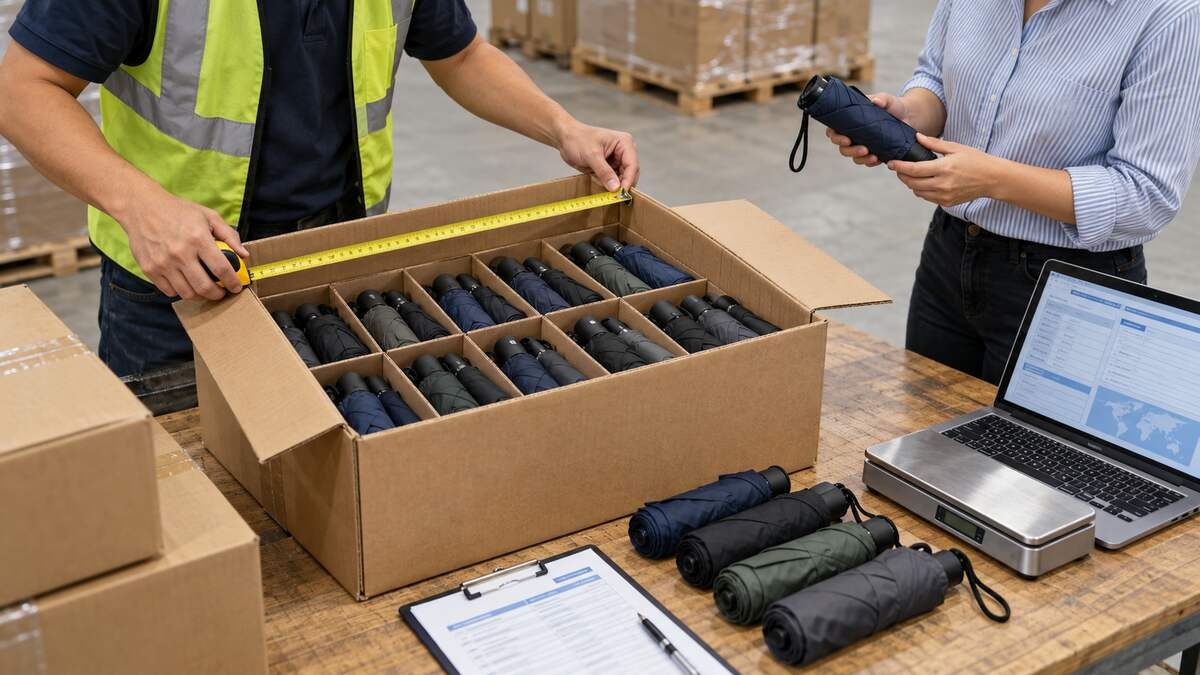
Unit packing affects both cost and volume. A pouch and protective bag may be adequate for bulk promotional distribution, while retail programs can require a band, barcode label, hangtag or printed carton. The quotation should name every layer and show the quantity per inner and master carton.
Request estimated carton dimensions, gross weight and carton count based on the quoted packout. For express and some other transport services, carriers compare actual weight with volumetric weight, which reflects the space a package occupies. DHL notes that the applicable divisor can vary by carrier and service, so the buyer should confirm the current calculation with the chosen forwarder.
Treat early carton figures as estimates until the final sample and packing arrangement are fixed. A larger handle, thicker retail box or lower pack quantity can change the total volume even if the umbrella itself remains the same.
Name the trade term place and rule version
EXW, FOB and DDP figures are not interchangeable product prices. They allocate different costs, risks and responsibilities between seller and buyer. The International Chamber of Commerce lists 11 Incoterms® 2020 rules and recommends writing the chosen rule with its named place and the 2020 version.
A line that says only “FOB China” is incomplete for comparison. The named port matters, as do local charges included before delivery under th e selected rule. A delivered quotation also needs a precise destination and a clear statement of what is included or excluded, especially duties, taxes, customs services and delivery surcharges.
Use the rule as part of the sales contract rather than as shorthand for a freight estimate. Buyers should confirm the appropriate term with their logistics or trade adviser for the actual route. The commercial quote should then repeat the exact wording used for the order.
Ask for dates with a clear starting point
“Production takes 30 days” is not a complete schedule. The clock may start after deposit, artwork approval, material confirmation or pre-production sample approval. State the starting event and whether the number refers to calendar days or working days.
Separate sample time, bulk production, inspection, booking and transit. A factory completion date is not the same as a vessel departure or arrival date. Seasonal capacity, custom-dyed fabric and complex printing can also change the estimate, so record the validity date of the schedule along with the price validity.
Payment terms influence the comparison too. Note the deposit, balance trigger, currency, bank charges and any letter-of-credit cost. If a quotation changes with exchange rates or raw-material prices, ask how and when the revised price will be confirmed.
Compare evaluated cost and the work still unresolved
Before accepting a custom umbrella quote, build one comparison sheet that adds the quoted units, one-time charges, approved packaging, testing and the transport scope needed for the decision. Keep uncertain items in a separate column rather than forcing them into a false total.
A useful custom umbrella quote should let another colleague understand the offer without searching through an email chain. Attach the specification revision, artwork version, packing description, sample plan, delivery basis, payment terms and validity date. Record every exclusion that could return as a later charge.
Buyers can use the VESTA umbrella collection to define the model family before requesting a price. For example, the 23-inch automatic folding umbrella and a custom printed golf umbrella have very different frame, packing and freight profiles. Send the intended model, destination, quantity split and artwork together. The resulting quotations will be easier to compare and much closer to the cost the project will actually carry.
Frequently asked questions
Why can two suppliers quote very different prices for the same umbrella
The descriptions may hide different fabric, frame, mechanism, printing, packing or delivery assumptions. Compare both offers against one dated specification and require each alternative or exclusion to be shown.
Does the minimum order quantity apply per color or to the whole order
It depends on how materials and printing are arranged. Ask for the total MOQ and the minimum per canopy color, print design, handle option and packing version before dividing the order.
What should be included in the umbrella unit price
The quotation should list the product configuration, included print, accessories and unit packing. Samples, setup, tooling, testing, inspection, freight and taxes should either be included clearly or listed separately.
Can buyers compare two FOB prices without naming the port
No reliable comparison can be made from “FOB” alone. Record the named port and the version of the Incoterms® Rules, then confirm which local charges and documents are included in each offer.