

How Should Buyers Choose a Motorcycle Umbrella Canopy?
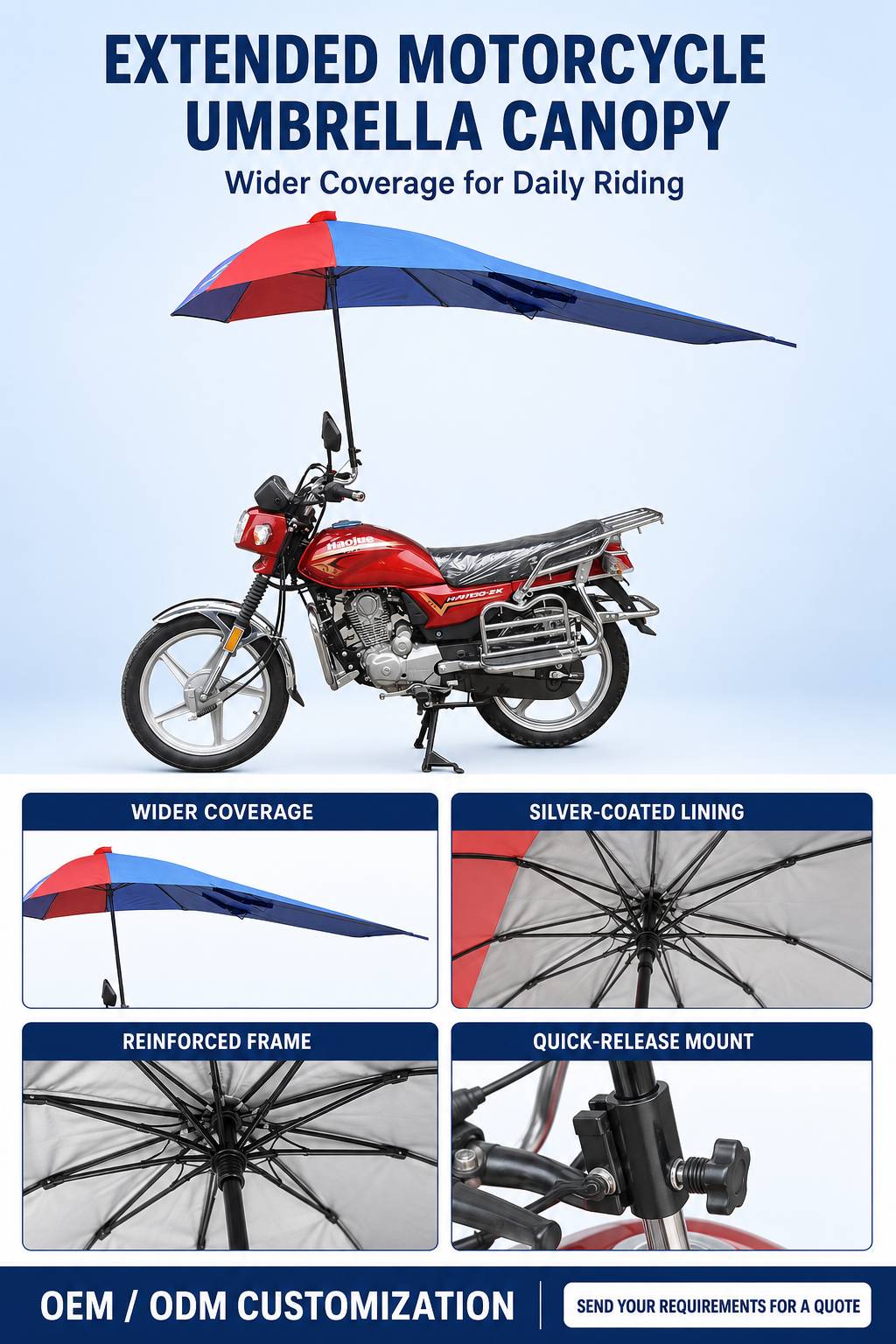
A motorcycle sunshade should be matched to the vehicle and the rider’s normal route.
A rider leaving home at seven in the morning may face cool air, hard sun by midday and a short downpour on the return trip. That is the everyday problem behind the motorcycle umbrella canopy. It is not a hand-held umbrella fixed to a handlebar. A properly designed version is an elongated cover supported at the front and rear of a compatible motorcycle, scooter or electric bike.
The idea is simple, but choosing the product is not. A canopy that feels comfortable on a slow delivery route may be unsuitable for a faster road or a windy coastal area. For an importer or distributor, the useful question is therefore not “Does it block sun and rain?” It is “Where will it be used, on which vehicles, and what evidence supports the specification?”
Begin with the rider’s normal route
Start by describing a normal working day. Is the product for short trips through dense city traffic, a campus shuttle, an electric-scooter fleet or a boda boda service carrying a passenger? How fast do the vehicles normally travel? Are sudden showers common? Is strong crosswind a regular concern?
These answers shape almost every later decision. A light removable canopy can make sense for low-speed urban travel in hot weather. A longer rear section is more useful when the passenger seat or a delivery load also needs overhead coverage. High-speed, off-road and severe-wind use should be treated as separate applications and should never be assumed from a general product photo.
Measure coverage instead of relying on “universal fit”
“Universal” is often used loosely in this category. Motorcycles differ in handlebar width, mirror position, seat length, rear rack design and available mounting points. Ask for a measurement drawing before approving a sample, then compare it with the vehicles used in the target market.
The drawing should show the canopy length, front and rear width, installed height, distance between mounting points and the space around the rider’s hands, mirrors and head. If a passenger is part of the intended use, confirm coverage with two people seated in a normal position. The canopy should not force either person to crouch or restrict the rider’s ability to look over a shoulder.
As one current example, VESTA’s extended model lists a 124 cm front canopy measurement along the fabric, a 115 cm straight-line front width and a rear section that can extend to 93 cm. Those figures are useful only when they are matched to the customer’s actual vehicle; they are not proof of fit for every bike.
Ask what the canopy fabric has actually been tested to do
A dark outer fabric or a silver-colored lining can reduce direct light under the cover, but color alone does not prove a UPF rating.
Rain claims need the same discipline. Coated polyester or Oxford fabric may shed a brief shower, yet water can still enter through seams, stitching or the open sides.
For buyers in hot climates, also inspect the inner surface after folding and rubbing. A coating that looks impressive on day one is of little value if it sticks, flakes or transfers during storage. A simple sample routine should include repeated opening and closing, wet-and-dry checks and several hours of outdoor exposure before the bulk order is confirmed.
The mounting system matters as much as the canopy
Most field problems begin at the connection points. A large cover catches air, and every vibration is transferred through the front and rear supports. Buyers should examine the clamp material, tube diameter, fasteners, anti-slip pads and the way the rear support connects to the rack or frame.
A quick-release arrangement is useful for storage and seasonal removal, but it still needs a positive lock. Thumb screws should tighten without damaging the vehicle, and replacement knobs, clamps and support tubes should be available. After installation, turn the handlebar fully in both directions and check the brake levers, cables, mirrors, lights and rider entry path.
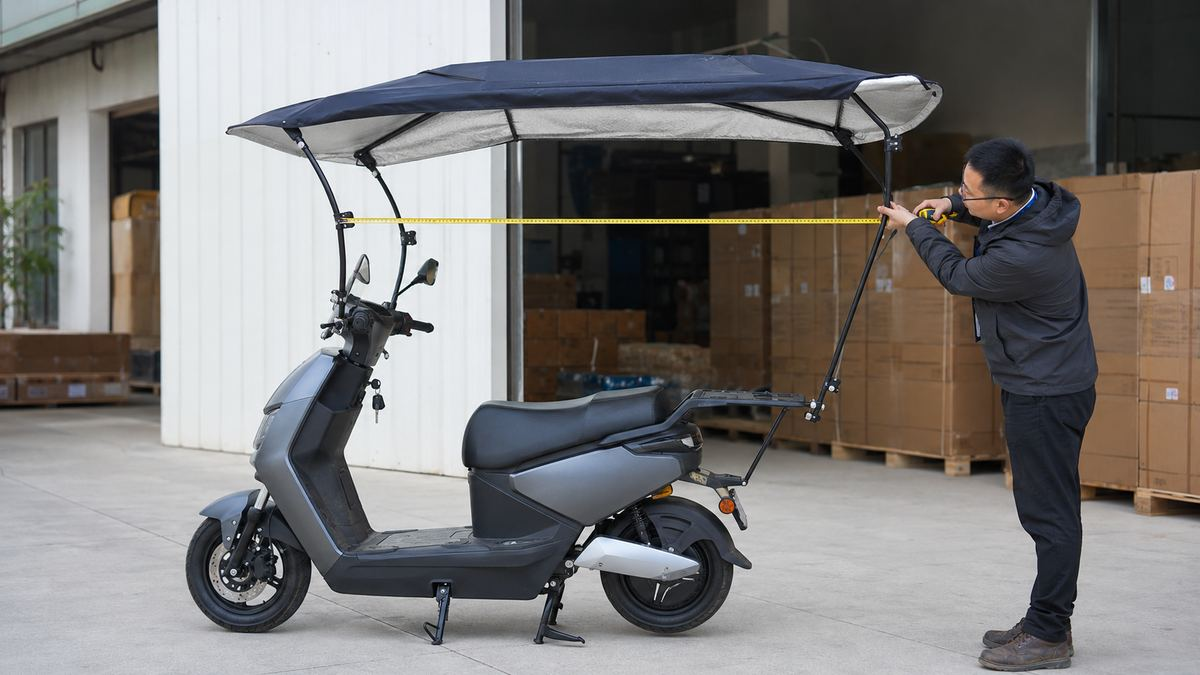
Sample approval should include canopy dimensions, handlebar clearance, front and rear attachment points and fastener security.
A canopy and a rain suit solve different problems
A canopy is convenient because it creates overhead shade without requiring the rider to change clothes. It can also keep part of a light shower away from the helmet, seat and upper body. That is particularly useful for short urban journeys and stop-and-go work.
A rain suit provides closer body coverage. It is less affected by the angle of the rain and usually makes more sense for longer trips or sustained wet weather. In wind-driven rain, water can travel under an open-sided canopy, so the two products should not be described as perfect substitutes.
For some markets the practical answer is a light canopy for sun and brief showers, with certified protective riding gear and a rain layer available when conditions change. The canopy is an accessory; it does not replace a helmet, safe riding practice or weather judgment.
Be precise about wind, speed and road legality
A supplier should not describe a motorcycle sunshade as “windproof” unless the claim is tied to a defined test method, installed configuration and operating limit. The size of the cover, rider speed and wind direction all change the load on the frame. Crosswinds are especially important because they can affect balance and steering feel.
What wholesale buyers should put in the RFQ
A useful request for quotation gives the supplier enough information to recommend a structure, not simply a unit price. Include the target country, vehicle photos, handlebar and rear-rack measurements, normal riding speed, rider-only or rider-plus-passenger use, expected rain and wind conditions, and the quantity for the first order.
- Canopy length, front width, rear width and installed height
- Fabric type, coating, color, seam construction and available test reports
- Frame and support-tube material, diameter and surface treatment
- Front and rear mounting method, fastener specification and spare parts
- Packed size, gross weight, carton quantity and assembly instructions
- Custom colors, logo area, print method, labels and retail packaging
- Sample lead time, production lead time and agreed inspection points
A product such as the extended double-layer VESTA motorcycle umbrella canopy can then be evaluated against a real brief. Its silver-coated lining, reinforced frame and thumb-screw quick-release mount are useful starting features, but the sample still needs to be checked on the buyer’s vehicle before production.

Approve the sample as a complete system
Treat the canopy, supports, fasteners and instructions as one product. Photograph the approved mounting position, record all dimensions and keep a sealed reference sample. If the order includes several colors or printed logos, approve the artwork scale and position on the fully opened canopy, not only on a flat fabric panel.
Finally, confirm which parts can be replaced without buying a complete new set. For fleet operators, a small stock of clamps, knobs and support tubes can be more valuable than a slightly lower initial price. Good after-sales planning is part of the specification, not an extra conversation after a failure occurs.
Final thought
The right motorcycle umbrella canopy is not the largest or the cheapest one. It is the model whose coverage, material, mounting system and stated limits fit a clearly defined route and vehicle. Buyers who begin with those details will receive more useful quotations, compare samples more fairly and avoid promises that a single accessory cannot keep.
VESTA motorcycle shade range supports custom colors, logo printing, mounting configurations and packaging for wholesale motorcycle-shade projects. Share vehicle photos, measurements, target quantity and expected operating conditions before requesting a sample.
Frequently Asked Questions
Is every motorcycle umbrella suitable for high-speed riding?
No. Canopy area, mounting strength, vehicle geometry and crosswind all affect handling. Use only within documented operating limits and local road rules; do not assume a general “windproof” label proves high-speed suitability.
Does “universal fit” mean no measurements are needed?
No. Buyers should still confirm handlebar clearance, mirror position, seat length, rear mounting points, installed height and the rider’s entry path on each target vehicle.
Can a motorcycle canopy replace a rain suit?
Not in every situation. A canopy offers overhead shade and light-rain coverage, while a rain suit provides closer body protection when rain is prolonged or driven from the side.
What can be customized for a wholesale order?
Common options include canopy color, logo printing, fabric and coating, front and rear coverage, mounting components, labels, instructions and retail or bulk packaging.