

What Makes a Commercial Patio Umbrella Ready for Daily Use?
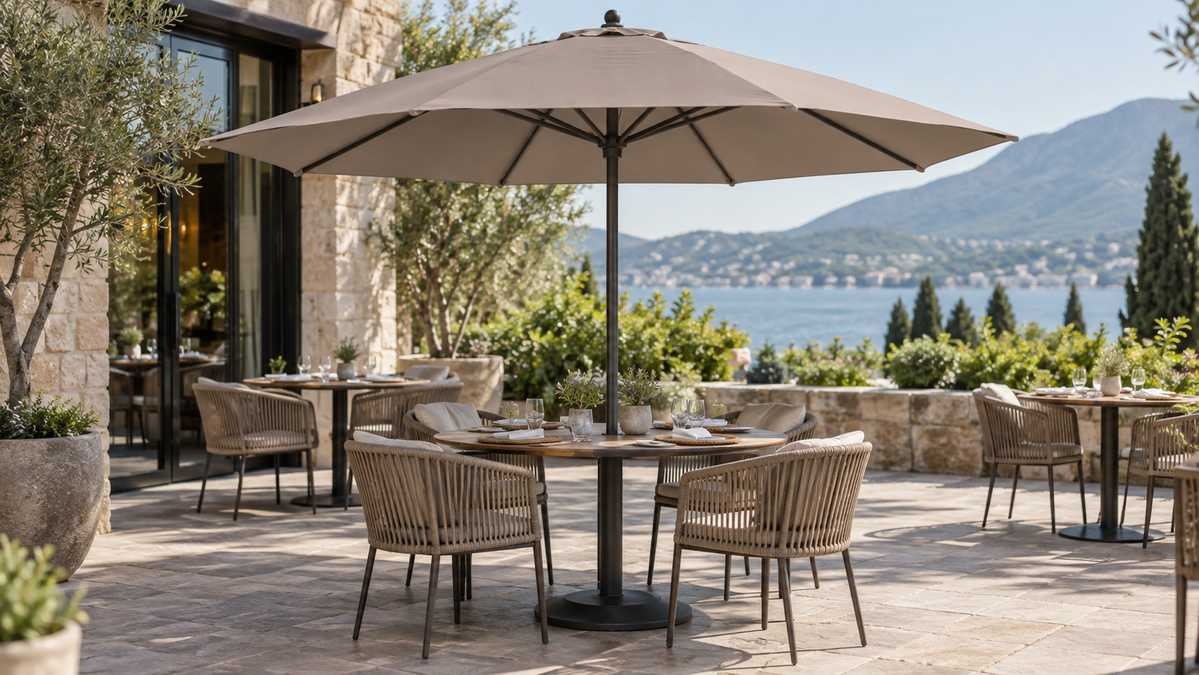
A center-pole market umbrella can work naturally with dining furniture when the table opening, mast and base are specified together.
At 8:30 in the morning, a café team opens six umbrellas before the first guests arrive. By lunchtime, chairs have moved, the sun has shifted and one canopy needs to be closed quickly as the weather changes. This routine tells you more about a commercial patio umbrella than a catalogue photograph ever will.
A broad canopy is useful, but only when the frame fits the furniture plan, the base fits the site and staff can operate the mechanism without forcing it. For wholesale buyers, the practical job is to connect those everyday details to a specification that can be sampled and checked before production.
Start with the way the space is actually used
Begin with a floor plan rather than an umbrella diameter. Mark the tables, chairs, walkways, doors, planters and any pool edge or fire feature. Then note where the sun falls during the hours when the space is busiest. A restaurant that serves breakfast may need shade from a low eastern sun; a hotel pool deck may need coverage that can be redirected through the afternoon.
The operator matters too. Will one person open twenty umbrellas every morning? Must the furniture remain in fixed positions? Is the site exposed to coastal air, dust or frequent rain? These are not minor questions. They determine the most useful mast position, lift system, finish, storage plan and spare-parts list.
Let the furniture plan choose the frame layout
A market umbrella places the mast in the center. It works naturally with a dining table that already has an umbrella hole, and the load path is comparatively direct. A cantilever model moves the mast to the side, leaving the area below the canopy open for lounge seating or a table without a center opening.
That freedom is not free of consequences. The side mast, arm, rotation mechanism and ballast occupy their own area, and the canopy may sweep across a larger circle when turned. A double-sided center-pole design is another option for a long table or two adjacent seating groups, but its opening effort, frame sections and anchoring must match the increased span.
|
Structure |
Best starting use |
Checks before approval |
|
Center-pole market umbrella |
Dining tables, compact café terraces |
Table-hole and closed-canopy clearance; pole diameter; separate base requirement |
|
Side-mast cantilever umbrella |
Lounge groups, pool decks, unobstructed seating |
Rotation sweep; mast position; ballast or fixed mount; lock and tilt operation |
|
Double-sided center-pole umbrella |
Long tables and grouped hospitality seating |
Lift effort; wide-canopy frame; site anchoring; carton length and service parts |
Measure shade as a footprint, not just a diameter
Umbrella size is commonly listed as a diameter or as the length of the canopy sides. Those figures do not describe the same geometry. A round canopy, a 3 × 3 m square canopy and a long rectangular canopy cast different shadows even when the headline measurement looks similar.
Measure the complete occupied area, including the chair position when someone pulls it back from the table. Add a sensible shade margin, then check the result against the sun path. Also request open height, valance height and closed-canopy clearance. A square canopy that shades a table well when open can still collide with chair backs or the tabletop when its ribs hang down in the closed position.
For example, VESTA’s 2.7 m crank-and-tilt market model is a center-pole format intended for compatible dining tables and bases. Its 38 mm pole is a useful reference, but the buyer still needs to confirm the table opening, connector dimensions, canopy height and base before treating it as a fit.
Specify the canopy, frame, mechanism and base as one system
Outdoor umbrellas are often quoted as if the canopy were the whole product. In use, the ribs transfer load to the hub, the hub transfers it to the mast, and the mast depends on the base or fixed mount. A stronger fabric cannot compensate for a loose joint, an underspecified support arm or a base chosen after the order is placed.
Ask for the mast profile, wall thickness, rib section, hub material, fasteners, frame finish and opening components. For crank models, confirm the cord, winding drum, handle and stop position. For rotating cantilevers, examine the pivot, lock and foot pedal or handle. The parts that wear first should be replaceable without discarding the complete umbrella.
Base selection must follow the exact canopy, frame and site. A table opening can help control a center pole, but it is not automatically a substitute for a suitable base. Offset designs usually need more ballast or a fixed installation because the canopy load sits away from the mast.
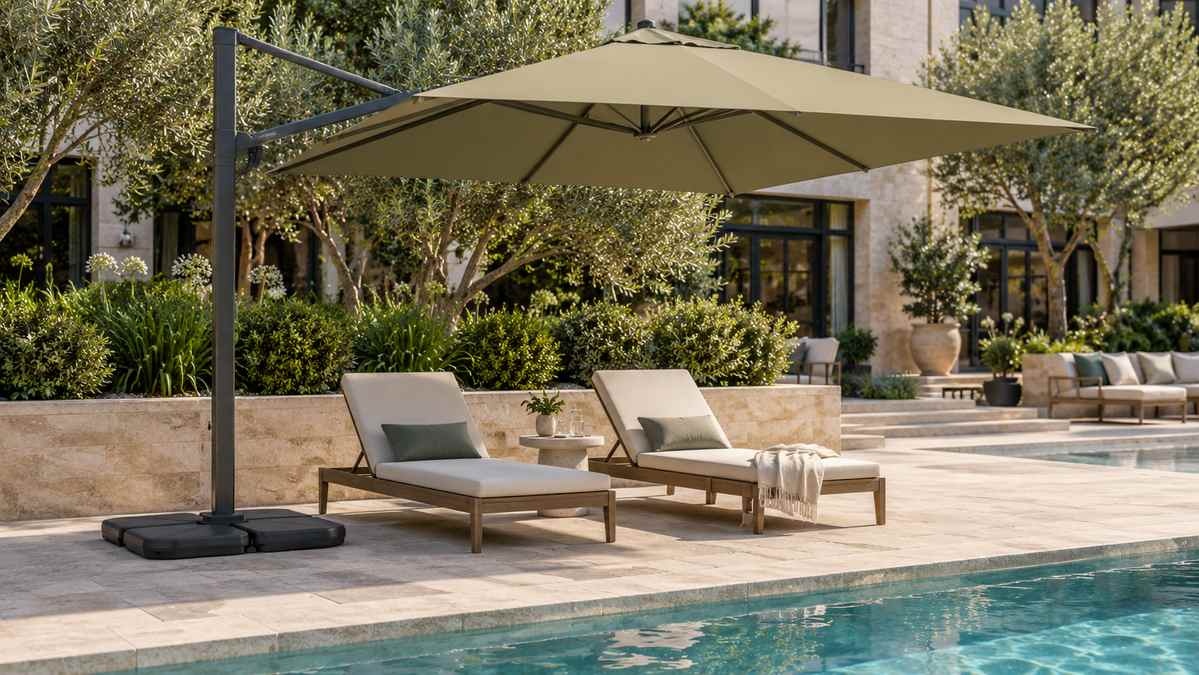
A cantilever layout keeps the seating area open but needs dedicated space for the side mast, rotation range and fully ballasted base.
Ask what the canopy fabric has been proven to do
Polyester, olefin and solution-dyed acrylic can all be appropriate, but the fiber name alone tells only part of the story. Request the fabric weight, yarn or dye method, coating, color, seam construction and relevant test report.
For a claimed UPF value or UV-blocking percentage, confirm the test method and sample description. For colorfastness, ask how the rating was obtained and what exposure it represents. Darker colors, heavier cloth and special coatings may change performance, so approving one color does not automatically validate an entire collection.
Rain language also needs restraint. A coated canopy can shed brief rain, yet seams, vents and open sides remain possible entry points.
Maintenance is part of the buying decision
For hospitality projects, add spare canopies, cords, crank handles, knobs, hubs and fasteners to the quotation discussion. A small service kit can be more valuable than a slightly lower opening price when replacing a complete unit would close part of a terrace.
Approve the sample in the same way it will be used
A commercial patio umbrella sample should be assembled with its intended base, on a surface similar to the final site and around the furniture it is expected to shade. Photograph the open and closed clearances, measure the canopy and mast, record the mounting arrangement and keep an approved reference sample.
Operate the mechanism repeatedly, inspect the fabric tension, check seam and vent construction, look for coating damage around fasteners and confirm that the canopy closes without pinching. If the product rotates or tilts, test every intended position and make sure the lock is clear to the user.
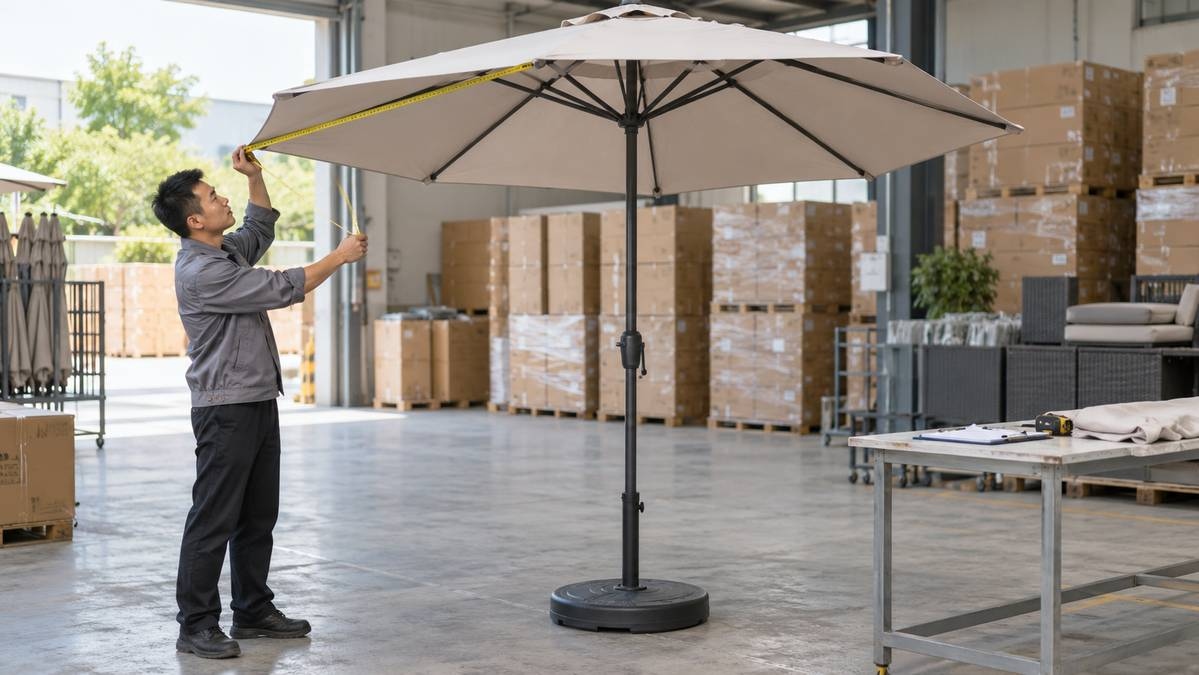
Sample approval should record canopy dimensions, frame components, opening operation and the complete base arrangement.
• Dimension drawing with open height, closed clearance and base footprint
• Canopy fabric, color, coating, seam construction and agreed test reports
• Mast, ribs, hub, fasteners, opening system and surface finish
• Base or fixed-mount specification for the approved site configuration
• Opening-cycle, tilt, rotation and user-instruction checks
• Replacement parts, spare canopy program and warranty process
• Carton protection, assembly guide, labels and destination-market requirements
These records turn a good-looking sample into a repeatable production standard. They also give the inspection team something specific to measure instead of relying on a general impression of quality.
Three structures for three different layouts
A 2.7 m market umbrella can suit a café table when the center pole, table opening and base work together. A 3 × 3 m Mini Roma cantilever keeps the seating area open and can add rotation or tilt, but its side mast and ballast need dedicated floor space. A 15 × 9 ft double-sided model covers a long hospitality arrangement from one central pole, while requiring a wider frame and a clearly specified installation.
Final thought
A useful outdoor umbrella is not defined by one impressive number. It is defined by how well the shade footprint, frame, fabric, mechanism and base work together through opening, service, cleaning and storage.
VESTA’s garden umbrella range includes center-pole, cantilever and wide double-canopy structures for wholesale and private-label projects. Share the site layout, intended quantity, target fabric, operating requirements, base plan and packaging needs when requesting a commercial patio umbrella sample.
Frequently Asked Questions
How large should a patio umbrella be for a dining area?
Measure the table and the occupied chair positions, then add a practical shade margin. Confirm the result against the sun path, canopy shape, open height and closed-canopy clearance rather than selecting by diameter alone.
Is a market umbrella or a cantilever umbrella better for a restaurant?
A center-pole market umbrella usually fits naturally through a compatible dining table. A cantilever keeps the space below open, which can suit lounges or tables without center holes, but it needs room for the side mast, rotation range and ballast.
Does a vented canopy make a patio umbrella windproof?
No. A vent may help relieve some pressure, but canopy area, frame geometry, base or mounting, wind direction and whether the umbrella is tilted all affect the load. Use only within the documented operating limits and close it when conditions require.
What fabric evidence should a wholesale buyer request?
Ask for the exact fiber, weight, dye or print method, coating, color, seam details and relevant reports for claims such as UPF, UV blocking, colorfastness or water resistance. Check that the report sample matches the production material.
What should be included with a commercial umbrella order?
Confirm the complete canopy and frame, the correct base or fixed mount, opening instructions, protective cover if required, spare parts, care guidance, labels, assembly information and export packaging before bulk production.