
Which Umbrella Materials and Finishes Should Buyers Specify?
Two umbrellas can look almost identical in a quotation photo and behave very differently after a season of use. The reason is usually hidden in the specification: the fiber and weave of the canopy, the combination of shaft and rib materials, the coating applied to each surface, and the printing process chosen for the artwork. This guide helps importers, promotional distributors and private-label brands make those decisions in a practical order. It explains why polyester and pongee are not always competing terms, when steel, aluminum and fiberglass work well together, how black and silver coatings should be assessed, and which printing methods suit spot-color or full-panel designs. It also gives buyers a sample-approval checklist that connects appearance to measurable requirements. The goal is not to nominate one universal best material. It is to build an umbrella specification that fits the product, the market and the price point without leaving important choices to assumption.
The first sample often arrives looking exactly right. The canopy color matches the artwork, the handle feels comfortable and the umbrella opens cleanly. Six months later, however, a retailer may be dealing with creased panels, chipped frame paint or a logo that no longer looks as crisp as it did in the sample room.
Those problems rarely begin with one obviously bad material. They begin when the order says only “pongee canopy,” “fiberglass frame” or “UV coating” and leaves the rest open to interpretation. A useful specification describes the complete construction and the way it will be checked.
Begin with the job the umbrella must do
A compact commuter umbrella, a promotional golf umbrella and a transparent children's umbrella do not need the same material package. Start with the product size, folded weight, opening system, climate, retail price and expected life. Then add branding and packaging. This order keeps a striking finish from forcing the wrong structure underneath.
For example, a travel umbrella may prioritize low weight and a neat folded bundle. A large golf model needs a frame that controls a much wider canopy. A corporate gift may need an exact brand color and a handle that feels substantial. The phrase umbrella materials and finishes becomes useful only after the intended product is clear.
Fabric names are only the beginning
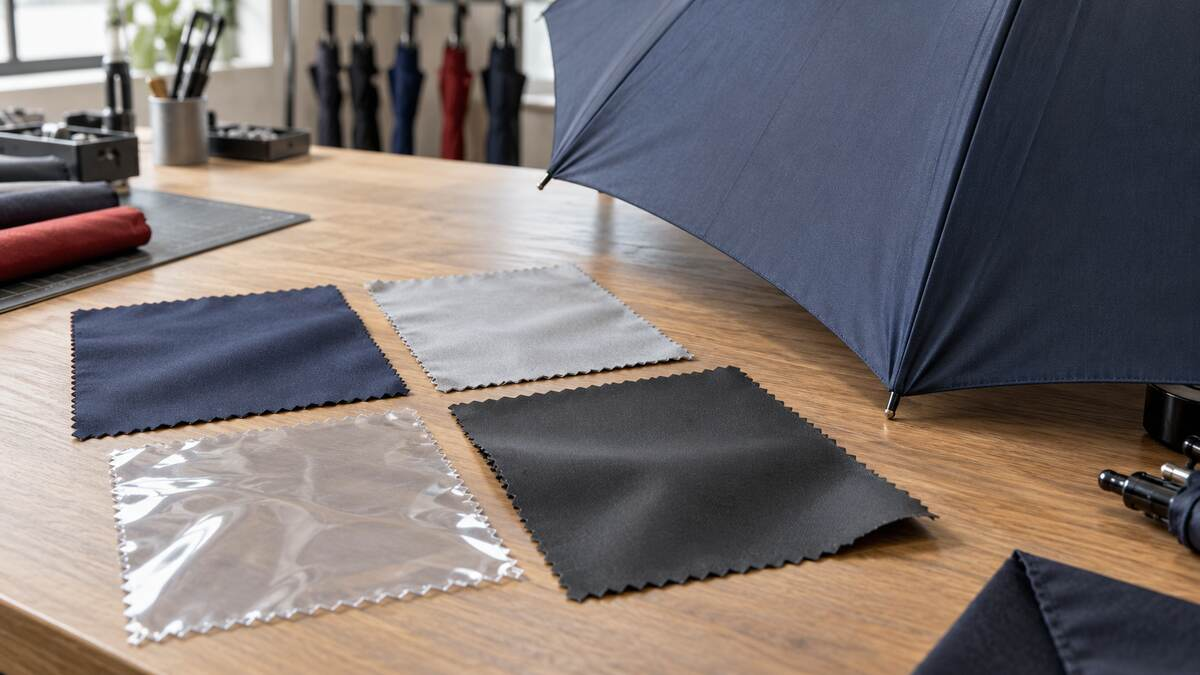
Polyester is common because it supports a broad color range, accepts several printing processes and can be sourced at different weights and constructions. Pongee is often described as a premium alternative, but the comparison can be misleading: many umbrella pongee fabrics are themselves polyester. In an RFQ, “polyester pongee” can be a more useful starting description than choosing one word and assuming the rest.
Nylon can offer a soft hand and low weight, although the exact construction still decides how it handles moisture, printing and repeated folding. Clear PVC or POE film serves a different design purpose. It gives visibility through the canopy but changes the feel, folding behavior, seam construction and packaging requirements.
Numbers such as 190T or 210T can help distinguish constructions within a supplier's range, but they are not a stand-alone quality grade. Ask for fiber content, weave or construction, finished weight if relevant, color standard, coating side and an approved cutting from the same material route intended for production.
|
Polyester canopy |
Broad color and print options; flexible price range |
Construction, finished weight, coating and color standard |
|
Polyester pongee |
Smooth hand and neat appearance for gift or retail lines |
Fiber content, weave, density reference and folding behavior |
|
Nylon canopy |
Soft, lightweight concepts where the exact construction fits |
Dimensional behavior, print compatibility and wet handling |
|
Clear PVC or POE |
Transparent fashion or children's designs |
Film thickness, cold-fold behavior, seams, odor and packaging |
Choose a coating by evidence rather than color
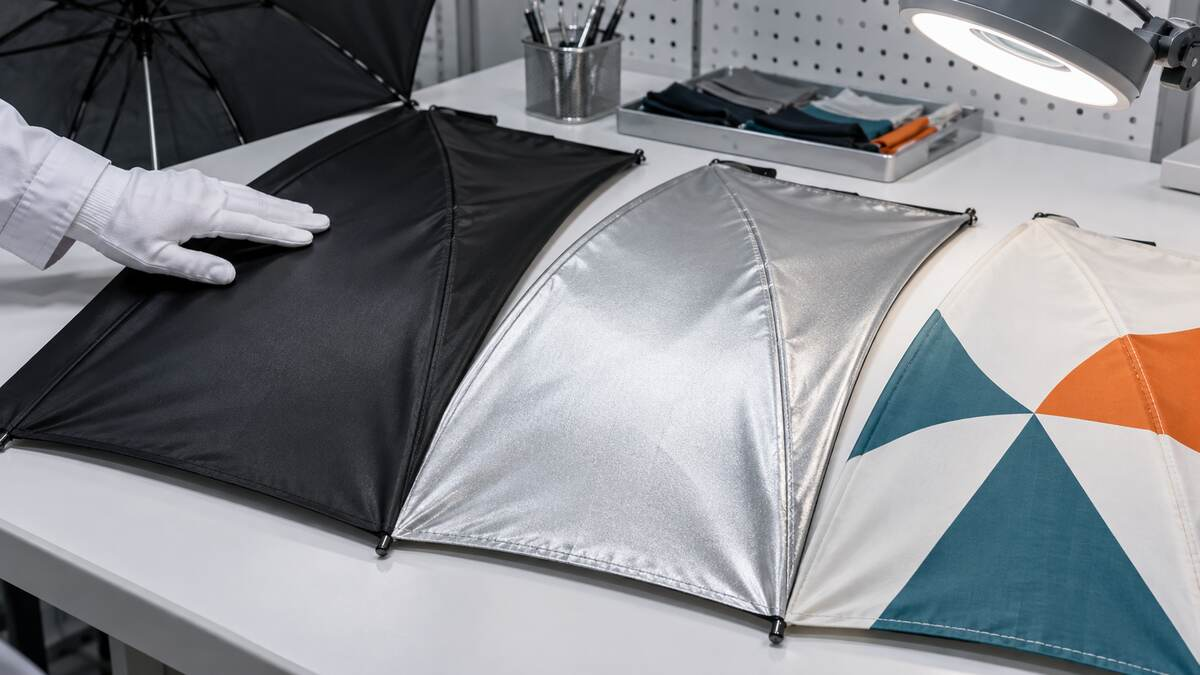
The canopy surface usually performs more than one job. A water-repellent finish helps rain bead on the outside. An underside coating may reduce light transmission or support a sun protection claim. Printing then adds another layer of ink or dye. Each process changes the look and hand of the same base cloth.
Black coating creates a dark underside and is popular in sun umbrellas where buyers want less visible light below the canopy. Silver coating has a bright reflective appearance and can suit promotional or value-oriented programs. Neither appearance proves a particular UPF rating, temperature reduction or service life. The report must identify the tested material clearly enough to match the approved production specification.
During sample review, open the canopy against a strong, even light and look across every panel. Check for pinholes, thin areas, edge marks and changes near seams. Rub a hidden area with the agreed method, fold and reopen the canopy several times, and note odor after the umbrella has remained in its retail sleeve. A coating that passes a headline test but arrives uneven or tacky will still create complaints.
Separate the shaft from the ribs
“Fiberglass frame” sounds complete, yet it may describe only the outer ribs. The shaft can be steel or aluminum; stretchers and joints may be metal; and the tips, runner and notch are separate components again. This is normal. A well-chosen hybrid can balance rigidity, recovery, weight and cost better than insisting that every part use one material.
Steel is useful where stiffness and cost control matter, provided the grade, section and corrosion protection fit the project. Aluminum reduces weight and does not rust in the same way as ordinary steel, but thin sections can still deform. Fiberglass ribs can flex and recover in gusts, yet their diameter, resin system, connectors and assembly quality still matter. None of these words, by itself, is a wind-resistance guarantee.
A large umbrella also changes the load. The reference version of VESTA's 62-inch foldable golf umbrella combines a black metal shaft with a fiberglass-reinforced rib system and a vented double canopy. A compact automatic model uses a different balance of metal and fiber components because folded length and opening mechanics matter more. The right comparison is between complete approved constructions, not isolated material names.
|
Frame approach |
Typical purpose |
Confirm before approval |
|
Painted steel shaft and metal ribs |
Cost-controlled straight or promotional formats |
Section sizes, finish adhesion, joints and corrosion requirement |
|
Aluminum shaft with selected metal parts |
Lightweight portable designs |
Tube wall, connection points, bending and operating cycles |
|
Metal shaft with fiberglass ribs |
Golf and larger canopies needing rib flexibility |
Rib diameter, connectors, stretchers and complete-frame test |
|
Carbon-fiber components |
Special lightweight premium programs |
Exact component coverage, supplier evidence and cost impact |
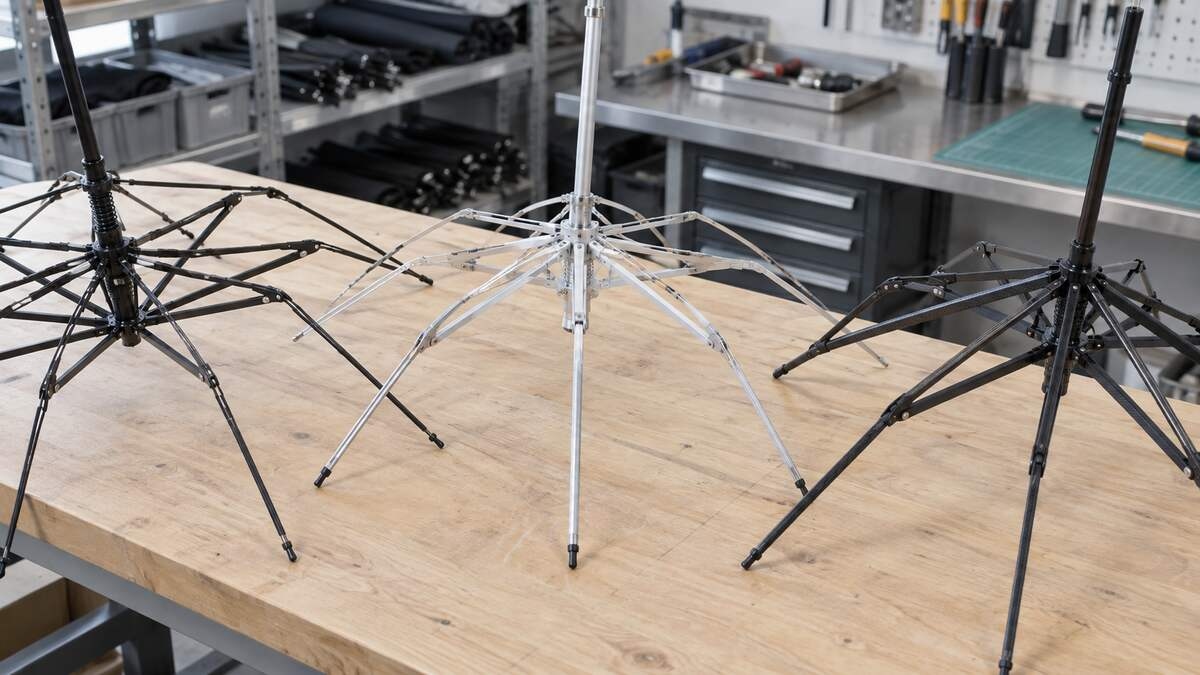
Steel, aluminum and fiberglass components are often combined within one frame. Review the shaft, ribs, stretchers and joints as a complete system. Editorial illustration; not a wind test.
Frame surface treatment belongs in the specification
The visible frame finish affects both appearance and how the product ages. Painted or powder-coated steel can provide a controlled black or brand-related color. Electroplated parts can create a bright decorative surface. Aluminum shafts may be anodized, painted or otherwise finished depending on the design. Wood handles and poles require their own stain, clear coat and color approval.
Do not approve a finish from a digital rendering alone. The sealed sample should show gloss level, color, surface texture and coverage around holes, rivets and moving joints. Ask what inspection will be used for adhesion, visible scratches and corrosion when those properties matter to the destination market. A beautiful coating on the straight sections is not enough if it chips at the runner after repeated opening.
Let the artwork choose the printing process
Screen printing remains practical for a bold logo in one or a few solid colors. It is easy to understand, economical at suitable quantities and works well when the print stays clear of seams and panel edges. Ask for the ink color reference, print size, position from the tip and edge, and the acceptable registration tolerance.
Heat transfer can handle smaller multi-color artwork and gradients, but the transfer film, edge shape and compatibility with the fabric or coating need approval. Dye sublimation is well suited to full-color artwork on compatible polyester fabric because the design is created before the panels are sewn. It also means panel cutting and seam alignment become part of the artwork review.
A photograph that crosses eight panels should be judged on an assembled sample, not only on a flat layout. A small chest-style logo on one panel needs a different proof. The VESTA wooden-handle promotional golf umbrella shows a straightforward use of a smooth pongee canopy as a branding surface, while other projects may call for alternating panel colors, edge-to-edge artwork or a printed sleeve.
|
Print method |
Often suits |
Approval focus |
|
Screen print |
Solid-color logos and simple graphics |
Ink color, opacity, registration and distance from seams |
|
Heat transfer |
Small multi-color logos and gradients |
Film edge, adhesion, flexibility and coating compatibility |
|
Dye sublimation |
Full-color or full-panel polyester artwork |
Panel cutting, seam alignment, color proof and fabric compatibility |
Approve a construction rather than a collection of swatches
A fabric swatch confirms color and hand, but it does not show how the material behaves over a rib, beside a seam or inside a tightly folded sleeve. A rib sample cannot reveal whether the runner catches. A print proof does not show whether artwork disappears into a fold. The pre-production sample is where umbrella materials and finishes finally meet.
Keep that sample sealed and record the parts that matter. Photographs are useful, but they should support a written specification rather than replace it. For a repeat order, identify any permitted substitute before production starts. “Equivalent material” is too broad when color, coating, rib recovery or packaging fit is important.
- Product size, rib count, open diameter or arc, folded length and target weight
- Canopy fiber, construction, finished color, coating side and approved reference cutting
- Shaft, rib and stretcher materials with dimensions or supplier component codes
- Runner, notch, spring, joint, tip and handle construction
- Frame color and finish with an approved gloss and surface reference
- Artwork file, printing method, ink or color reference, dimensions and panel position
- Opening and closing function, cycle requirement and any agreed wind or inversion test
- Water repellency, UPF, colorfastness or chemical tests required for the destination market
- Sleeve, labels, carton packing, humidity control and spare-parts requirement
Build the RFQ around decisions that can be checked
A clear RFQ does not need to dictate every factory process. It needs to state the use case, non-negotiable performance points, appearance standard, test requirement and commercial target. The supplier can then suggest a construction and explain the tradeoffs before the price is fixed.
This approach also makes value engineering more honest. If a lower price is needed, the buyer can see whether the change is in fabric construction, frame section, finish, print coverage or packaging. That is far safer than approving a cheaper quotation with the same short product name and discovering the changes after shipment.
VESTA's umbrella range covers compact, straight, golf, advertising and specialist formats. For an OEM discussion, send the intended market, quantity, target size, artwork, canopy and frame preferences, test standard and packaging plan. These details give the sample team something concrete to build and give your inspection team something concrete to verify.
When umbrella materials and finishes are written this way, the quotation becomes easier to compare, the approved sample carries more meaning and later repeat orders are less dependent on memory. That is the practical value of a complete material specification.
Frequently Asked Questions
Is pongee better than polyester for an umbrella?
Not as a universal rule. Many pongee umbrella fabrics are made from polyester, so the terms may describe different parts of the specification. Compare the exact fiber, weave, weight, finish, sample appearance and required tests instead of judging by one material name.
Are fiberglass umbrella ribs always windproof?
No. Fiberglass can add useful flexibility, but the rib diameter, connectors, stretchers, shaft, joint design, canopy size and complete assembly determine how the umbrella behaves. Ask for the test method and approved construction behind any wind-resistance claim.
Is black coating always better than silver coating?
Black coating often gives a darker underside, while silver coating gives a reflective appearance. Actual UV performance, light transmission, adhesion and durability depend on the complete fabric and coating system. Use test evidence for the exact production material.
Which umbrella printing method is best for a logo?
For a simple spot-color logo, screen printing is often the practical starting point. Heat transfer can suit compact multi-color artwork, and sublimation can suit full-panel graphics on compatible polyester. The final choice depends on artwork, fabric, coating, order quantity and durability target.
Previous:No News