
How Should Buyers Prepare Custom Umbrella Artwork Files?
Send an editable vector file for logos and lettering
For custom umbrella artwork made from shapes and text, an editable vector file is usually the cleanest production input. AI, EPS and genuinely vector-based PDF files can be enlarged without creating jagged edges. They also allow the prepress team to separate spot colors, adjust trapping where required and place the design accurately inside the umbrella panel template.
A filename does not prove that a file contains vectors. A low-resolution JPEG saved inside a PDF is still a low-resolution image. Ask the designer or supplier to confirm whether the paths remain editable. Keep one untouched master file, then send a production copy with unused layers removed and linked assets embedded or supplied separately.
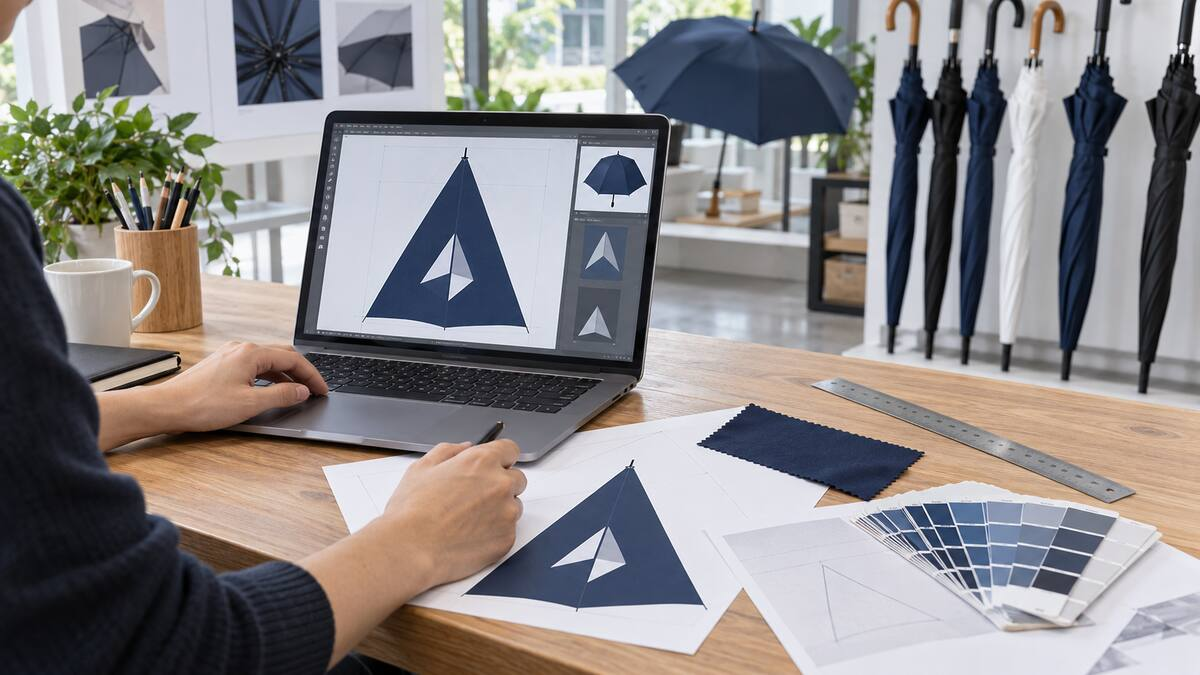
The supplier can price and place the design more accurately when the original artwork, panel template and color reference arrive together.
Treat photographs and raster artwork at final print size
Photographs, painted illustrations and textured graphics are raster images. Their pixels are fixed, so enlarging a small web image cannot restore detail that was never captured. A supplier may ask for 150 or 300 pixels per inch, but the useful requirement is resolution at the final print dimensions. A 300 ppi image that is enlarged to twice its width becomes 150 ppi.
Send the largest original image rather than a version copied from a website, presentation or messaging app. Those files are often compressed. Confirm the intended print size and ask the supplier for the minimum effective resolution for the selected process. Full-panel photographic work may also require bleed beyond the cut line, while a contained logo normally does not.
Upscaling software can make edges look smoother, but it may invent texture and alter small brand details. Use the enlarged result only after comparing it with the approved original. Fine legal text, certification marks and QR codes deserve separate checks because they can fail even when the overall picture looks acceptable.
Place the design inside the supplier's exact panel template
An umbrella panel is a curved triangle, not a rectangular poster. Its visible area changes when the panel is sewn to its neighbors and pulled over the ribs. The tip, side seams, lower hem and highly curved crown reduce the area that can carry a clean, readable mark.
Request the template for the chosen model rather than reusing a generic eight-panel outline. Two umbrellas with the same open diameter can have different panel proportions, seam allowances and crown depth. Work at the template's stated scale and keep the cut line, seam line, safe area and artwork layer separate.
Define placement with measurements. Record the finished logo width and height, its orientation, the panel number and its distance from fixed reference points such as the lower hem or both side seams. Saying centered is not enough when the visible panel is curved. For two opposite panels, identify which panels are paired so the logo faces the intended directions when the umbrella is open.
Decide how seams folds and the center crown affect the image
The safest position for a standard corporate logo is usually inside one panel with clear space around the seams. Thin lettering placed near a fold can disappear when the umbrella is closed. A transfer edge may also become more noticeable after repeated folding if it sits on a hard crease.
Artwork that spans several panels needs a different approval standard. The factory cuts individual pieces, prints them in a defined sequence and then joins them along curved seams. A continuous line may shift slightly from one panel to the next. Faces, small text and product outlines should not sit on a seam unless the design deliberately accepts that interruption.
Inside-canopy printing adds another decision. Confirm which side of the fabric is printed, whether the design should read correctly from below and how much it may show through to the outside. Coatings, lining layers and fabric color can change opacity. These points belong in the artwork brief before sampling.
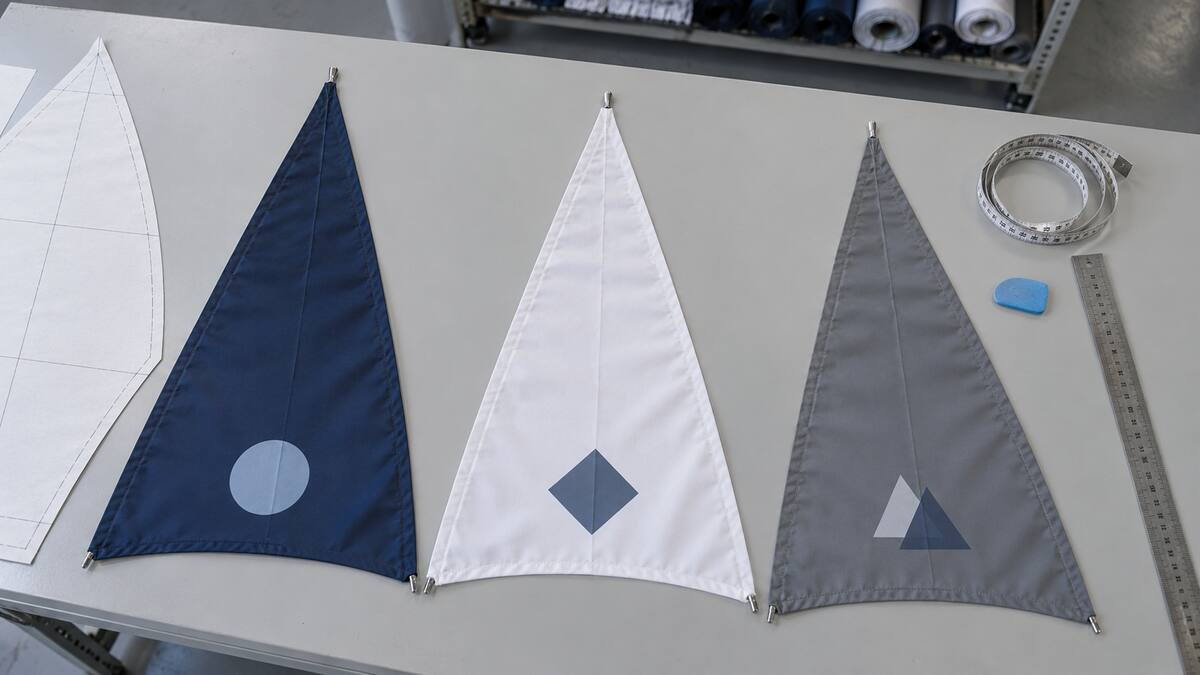
Logo size and placement should be measured from fixed panel references rather than described only as centered.
Specify color with a reference the production team can use
A color sampled from a monitor is not a reliable production standard. Screens use emitted RGB light, while printing depends on ink or dye, fabric color, coating, surface texture and viewing light. The same numeric value can look different on two screens, and a CMYK recipe can change between output systems.
For a solid corporate color, provide the agreed Pantone reference or another physical standard accepted by both sides. Also state whether the requirement applies to the printed logo, the dyed canopy, or both. A Pantone number used for ink does not guarantee that a dyed textile will match it exactly, so define an acceptable tolerance and approve the result on the intended production material.
For photographic or process-color artwork, ask for a strike-off on the actual fabric when color matters. Compare it under agreed lighting and keep the approved sample. A digital proof is useful for content and layout, but it cannot reproduce the exact way a navy pongee, a white polyester or a coated panel reflects light.
Use the digital proof to confirm facts that can be checked on screen
The digital proof should identify the umbrella model, canopy color, artwork version, print size, panel positions, orientation and color references. Check spelling, trademark symbols, line breaks and the direction of every logo. Review the umbrella fully open, not only as one isolated flat panel.
Measure the scale instead of judging it from a small preview. If the proof states a 220 mm logo, confirm that the dimension refers to the finished printed width and not the width of a surrounding artboard. Check whether white areas are intended as white ink, unprinted fabric or transparent space. That distinction matters on colored canopies.
Approval should name the file version and date. Comments such as use the last logo or make it slightly higher leave room for different interpretations. Mark the revision on the proof, obtain a clean updated version and approve that version in writing before the supplier prepares screens, transfers or full-panel production files.
Use a physical sample to confirm what the screen cannot show
A finished sample reveals how the artwork sits on the curved canopy, how opaque the color appears and what happens when the umbrella is folded into its sleeve. Open it under neutral light and view it from the expected distance. Check every printed panel, the distance from the seams, registration between colors and any visible edge around a transfer.
Close and reopen the umbrella several times. Inspect the folds for abrasion, sticking, cracking or unwanted transfer. Check the sleeve as well if it carries matching artwork. The sample should use the intended canopy fabric, coating and printing route. A white sample cloth proves very little when production will use a dark coated fabric.
Photographs help teams communicate, but retain a sealed physical sample for a new design or high-value order. Record any approved deviation and label the sample with the project and artwork version. The bulk inspection team then has a real construction to compare with the shipment.
Freeze the artwork specification before bulk production
After sample approval, combine the key decisions in one controlled specification. Include the product code, canopy material and color, artwork filename, print process, finished dimensions, panel positions, color references, placement tolerances, packing orientation and approved sample reference. If the supplier changes a fabric, coating or print route, require confirmation before production continues.
Bulk inspection should compare units from different cartons with the approved specification and sample. Look for missing or reversed prints, inconsistent positions, obvious color shifts, poor opacity, incomplete coverage and marks caused during folding or packing. For multi-panel artwork, inspect the umbrella fully open so alignment can be judged across the canopy.
Keep the same files and references for repeat orders. Recreating a logo from a photograph or an old sample adds avoidable variation. A controlled custom umbrella artwork package makes quotations easier to compare and repeat production easier to reproduce, especially when several people handle the project over time.
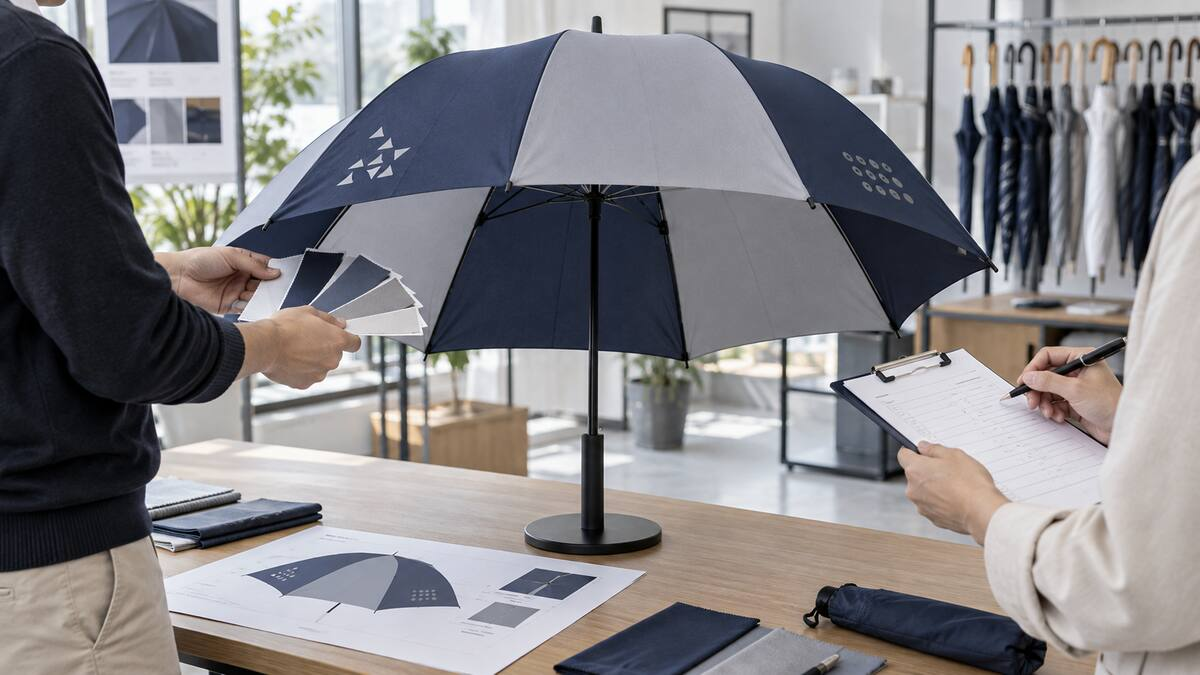
The finished sample shows color, opacity, seam clearance and folding behavior that a screen proof cannot reproduce.
Send a brief the supplier can quote without guessing
A useful custom umbrella artwork RFQ can fit on one page. Attach the editable artwork, panel template or requested placement sketch, color references and any brand rules that affect minimum size or clear space. State the umbrella model, quantity, canopy material, finished logo size, printed panels, delivery market and whether you need a digital proof, strike-off or complete sample.
Ask the supplier to confirm what is included in the quotation: artwork preparation, setup charges, number of print positions, sampling route, expected production tolerance and any agreed test. Two quotations with the same unit price may cover different logo sizes or panel counts, so compare the defined output rather than the short product name.
VESTA's umbrella range includes compact, straight, golf and promotional models for OEM projects. Buyers can use the 23-inch automatic folding umbrella as a reference for compact panel branding, while a custom printed golf umbrella offers a larger viewing area. Send the intended artwork and use case with the inquiry so the sample team can recommend a workable layout.
Artwork handoff checklist
· Umbrella model, open size, canopy material, coating and finished canopy color
· Order quantity, destination market, event date and required delivery date
· Editable vector file or highest-resolution original raster artwork
· Artwork version, finished logo width and height, orientation and panel positions
· Pantone or other agreed color reference and acceptable production tolerance
· Supplier panel template with cut line, seam line, safe area and bleed where required
· Digital proof, strike-off or complete physical sample required before production
· Approved sample retention, bulk inspection points and repeat-order file control
Frequently asked questions
Which file format is best for an umbrella logo
An editable AI, EPS or vector PDF is usually preferred for logos and lettering because it can be resized and separated into production colors. Confirm that the file contains real vector paths rather than an embedded low-resolution image.
Is a PNG file good enough for umbrella printing
It can be suitable for some full-color work if it has enough pixels at the final print size and the supplier accepts it. A small web PNG is not suitable simply because its background is transparent. Ask for the required effective resolution and provide the original file.
Should the logo touch an umbrella panel seam
A contained corporate logo is normally easier to control when it stays inside one panel with agreed clearance. Designs can cross seams, but alignment variation and interruption must be reviewed on an assembled sample before bulk production.
Why does the physical sample look different from the digital proof
The proof is viewed on a light-emitting screen. The sample uses real fabric, ink or dye, coatings and reflected light. Use the proof for content and placement, then use the production-material sample to approve appearance and folding behavior.