
Which Umbrella Logo Printing Method Fits Your Artwork
Start with the artwork and use case
Most custom umbrella enquiries begin with a familiar request: put this logo on that umbrella. The useful questions come next. Is the artwork one solid color or a photograph? Does it need to sit on one panel or cover the whole canopy? Will the umbrella be a short-term event giveaway, an executive gift or a retail product expected to look good after repeated folding?
Those answers narrow the process quickly. A one-color mark on 5,000 promotional umbrellas has different production needs from a full-panel illustration on 200 premium umbrellas. The canopy color matters too. A dark logo may disappear on navy fabric, while a white transfer may need an opaque base layer. The same artwork can therefore require different treatment on two umbrella styles.
Before asking for a price, send the original vector file when available, the required logo dimensions, the number of print positions and a color reference. Also identify the viewing priority. A golf-event sponsor may want the mark visible from several directions. A corporate gift buyer may prefer a quieter logo on two opposite panels. These decisions belong in the quotation, not in a message sent after production has started.
Screen printing suits clear spot color logos
Screen printing remains a practical choice for simple artwork and repeat quantities. A stencil is prepared on a mesh screen, and ink is pushed through the open area onto a flat canopy panel. Each spot color normally needs its own screen and registration step. This is why a bold one- or two-color logo is usually easier to control than artwork built from many shades and gradients.
The process works well when the logo has clean edges, readable lettering and enough distance from the seams. It can also give good opacity, but the result depends on the ink system, fabric surface, coating and curing conditions. A white logo on a black-coated panel may need a different ink or application approach from a dark logo on uncoated white pongee.
Buyers should approve the print size, Pantone or other agreed color reference, position from the panel tip and distance from both seams. Ask whether the quoted price covers one panel, two opposite panels or every panel. Small wording differences can create a large cost difference when each color and position requires another setup.
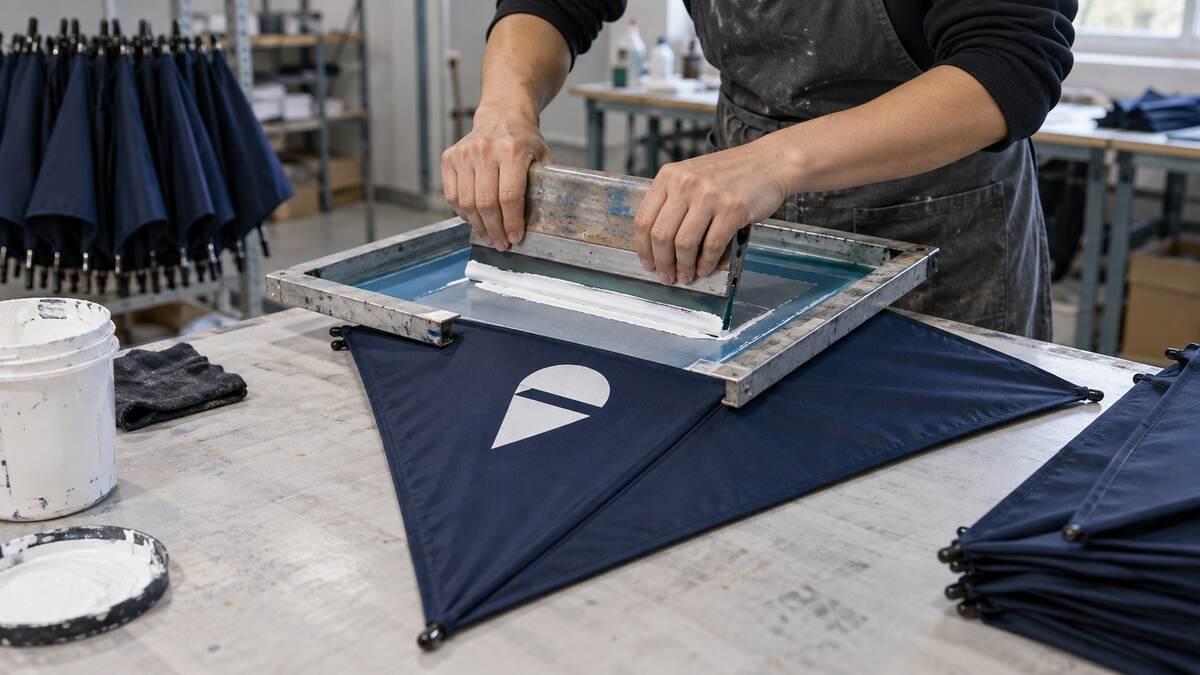
Screen printing is easiest to control when the spot-color artwork, print size and distance from the panel seams are approved before production.
Heat transfer handles detail within a defined area
Heat transfer is often considered when a logo contains several colors, fine lines or a gradient that would be cumbersome to separate into spot-color screens. The artwork is prepared on a transfer medium and applied to the fabric with controlled heat and pressure. The printed area may feel slightly different from the surrounding canopy because the transfer sits on or bonds with the surface as a distinct layer.
This route can be useful for a compact multi-color mark, especially when the print remains inside one panel. It is less forgiving when the transfer crosses a seam or a hard fold. Large solid transfer areas can also change the hand of a lightweight canopy. Fabric coatings and heat sensitivity must be checked because temperature and pressure that work on one polyester construction may affect another surface differently.
A sample should be folded and opened several times after the transfer has cooled. Look at the edges, fine lettering and any sharp corners. Rub the surface using the inspection method agreed with the supplier, and confirm whether slight texture or edge visibility is acceptable for the project. A digital mock-up cannot answer those questions.
Printing Method Comparison
|
Method |
Often suits |
Approval focus |
|
Screen printing |
One to four spot colors, bold logos, repeat quantities |
Ink opacity, registration, curing, seam distance and setup per color or position |
|
Heat transfer |
Compact multi-color logos, gradients and fine detail |
Transfer edge, fabric and coating compatibility, heat response and fold durability |
|
Dye sublimation |
Photographic, tonal or full-panel artwork on compatible polyester |
Base fabric color, color proof, panel cutting, seam alignment and complete sample |
|
Direct digital process |
Supplier-specific detailed artwork or short-run applications |
Exact machine and ink system, pretreatment, fabric compatibility and durability evidence |
Dye sublimation is designed for the whole panel
Dye sublimation is the natural candidate for photographic artwork, smooth color transitions and designs that extend across most or all of a canopy panel. The design is printed with sublimation ink and transferred under heat so the color enters compatible polyester fibers. Because the image is formed within the material rather than as a thick surface layer, the fabric can retain a relatively natural feel.
The method has material limits. It normally performs best on light-colored, compatible polyester. Sublimation does not provide an ordinary white ink, so the base fabric influences every light area in the design. Dark fabric cannot simply be treated as a blank white page. The supplier should confirm the exact cloth, pre-treatment if any, transfer conditions and the color-proofing route.
Full-panel artwork also makes cutting and sewing part of print approval. A landscape that looks continuous on a flat layout may shift where panels meet. Important text, faces or product details should not sit directly on seams or at the highly curved crown. Approve an assembled umbrella when alignment matters; a printed fabric roll or loose panel is not enough.
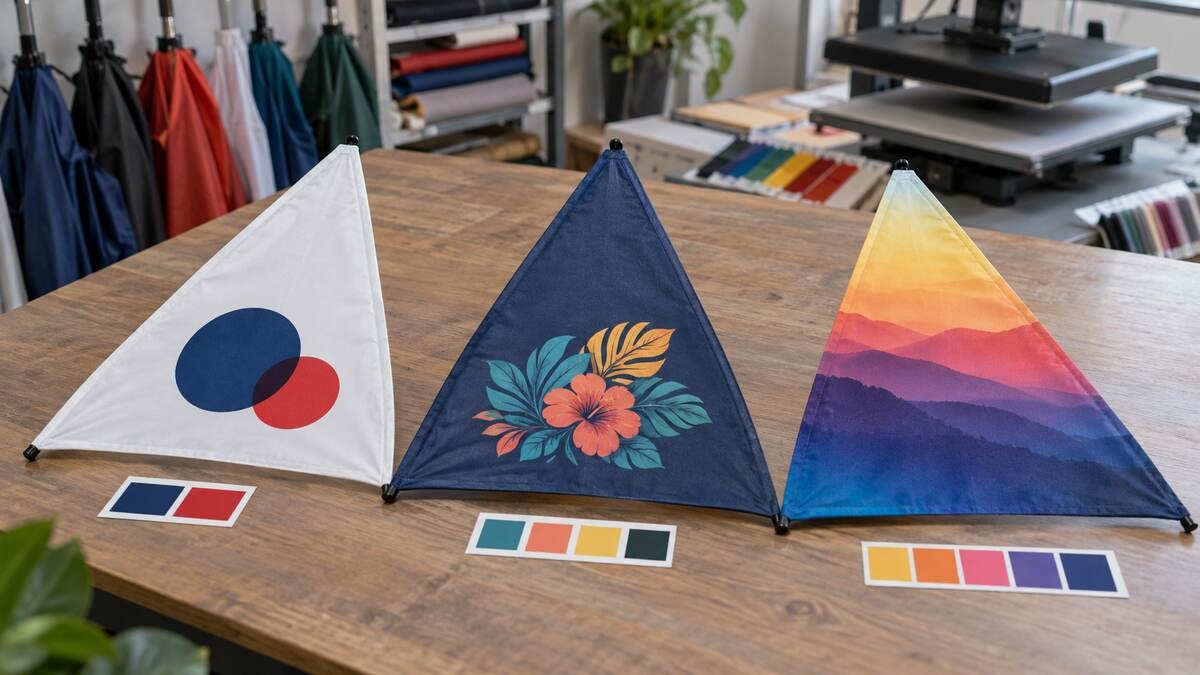
The artwork should determine the process: spot-color graphics, defined multi-color marks and full-panel designs require different production routes.
Clarify what digital printing means in the quotation
Digital printing is useful language in design discussions, but it is not always a complete production specification. One supplier may use the term for a direct-to-fabric process, another for a digitally printed heat transfer, and another for dye sublimation. The finished look, fabric compatibility and durability can differ even when all three quotations say digital print.
Ask the supplier to name the actual process, the ink or transfer system, the compatible fabric and whether the artwork is applied before or after the panels are cut. Confirm which side of the cloth is printed and whether the design is expected to show through to the reverse. If a coating is present, identify its side and check whether it changes ink adhesion or color appearance.
The three main umbrella logo printing methods are easier to compare when the quotation describes what happens to the material. Process names should lead to checkable construction details, not act as shorthand for an unspecified full-color result.
Design for triangular panels seams and folds
An umbrella canopy is not a rectangular banner. It is assembled from curved triangular panels that rise toward the top notch and fold along the ribs. The usable print area is smaller than the visible panel because the edges become seams and the lower corners curve when the umbrella opens.
For a standard corporate logo, keeping the complete mark inside one panel is usually the safest starting point. Give small text enough space from the seam and avoid placing a thin tagline directly on a fold. If the design spans several panels, prepare an assembled-view proof as well as individual cutting files. The factory must know which elements are allowed to move and which must align precisely.
Placement should reflect how the product will be seen. Two opposite panels often provide balanced visibility without printing every section. Alternating panels can support a repeating campaign pattern. Inside-canopy printing needs a construction designed for that purpose and should be discussed before sampling. The VESTA custom 23-inch fully automatic umbrella is a useful reference for compact panel branding, while a custom printed golf umbrella provides a much larger viewing area for event artwork.
Match the print to the fabric and coating
Pongee, plain polyester, nylon and coated sunshade fabrics do not present the same printing surface. Even two fabrics sold under the same general name can differ in weave, finished weight, water-repellent treatment and surface energy. These differences affect ink holdout, edge sharpness, opacity and curing.
The canopy color changes the result before any ink is applied. A transparent or pale ink may take on the tone beneath it. A black or silver underside coating can also affect heat behaviour and the appearance of the outer face. For this reason, the strike-off should use the intended production cloth and coating, not a convenient white sample fabric.
If color accuracy matters, provide a physical reference or an agreed color system and define the viewing conditions for approval. A monitor screenshot is not a reliable color standard. The approved sample should record the canopy batch reference, print process, ink or transfer details and acceptable color tolerance so repeat orders are less dependent on memory.
Approve a physical sample before bulk production
A flat proof checks spelling, scale and approximate placement. It does not show how the logo looks across a curved canopy, how the ink behaves near a fold or whether a transfer edge becomes visible after packing. For a new design or a high-value order, approve a complete pre-production sample made with the intended umbrella, fabric, coating and print process.
Open the sample under neutral light and view it from the distance at which the logo should be readable. Check the orientation on every printed panel, the distance from seams, registration between colors and the opacity of light inks. Close the umbrella, fit it into the sleeve, leave it packed for an agreed period, then reopen it and inspect the printed area again.
Photographs are useful for quick communication, but a sealed physical sample gives the production and inspection teams a clearer reference. Record any permitted variation in writing. If the logo must match a launch campaign or licensed artwork, vague notes such as similar color or normal position are not sufficient.
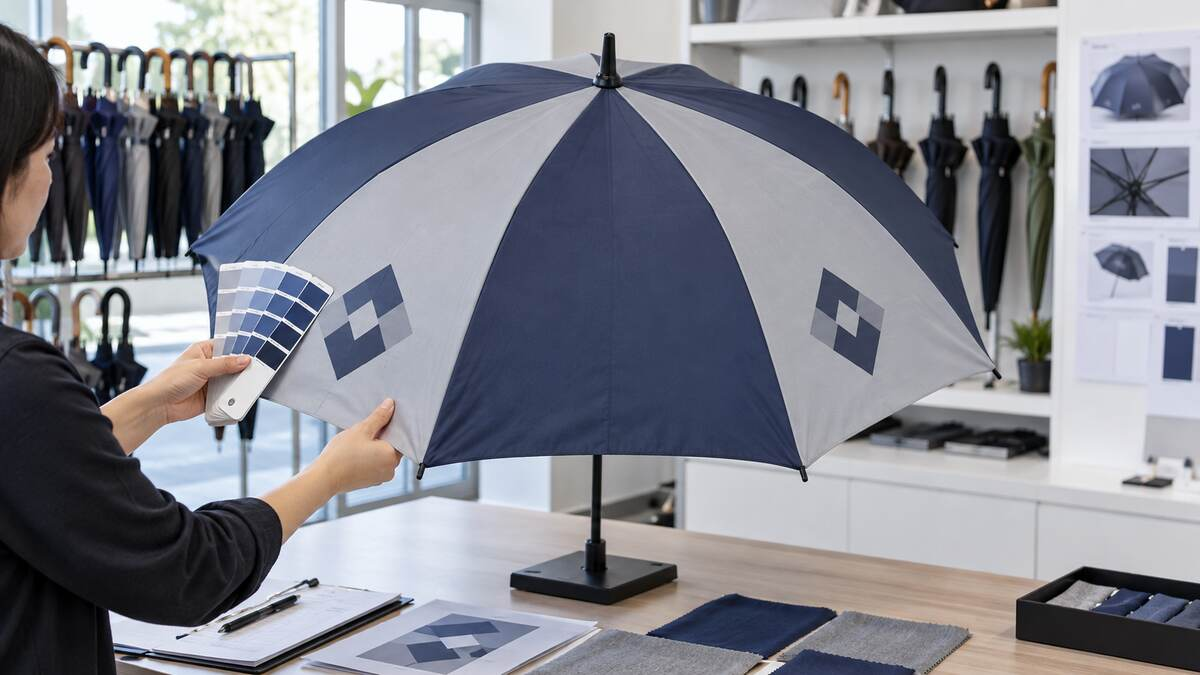
A complete umbrella sample reveals color, placement, seam distance and folding issues that a flat proof cannot show.
Inspect the bulk order against the approved construction
Bulk inspection should compare the shipment with the approved sample and specification. Start with quantity and print positions, then check a distributed sample from different cartons. Look for missing panels, reversed artwork, obvious color shifts, ink marks, incomplete coverage, transfer lifting and damage caused during folding or packing.
Registration and position should be judged with an agreed tolerance rather than by eye alone. Measure the print from the same panel reference points used during sampling. For multi-panel graphics, inspect the umbrella fully open. For compact umbrellas, also check the sleeve because tight packing can reveal abrasion or transfer problems that are not visible on an unpacked sample.
The inspection method should match the claim. A visual logo check does not establish weather resistance, and a simple hand rub is not a universal durability test. If the project requires wash, rub, adhesion, colorfastness or weathering performance, agree on a named method, test conditions and acceptance level before production.
Build the RFQ around decisions the factory can verify
A useful RFQ gives the supplier enough information to recommend a process and gives the buyer enough detail to compare quotations. Include the umbrella style, quantity, destination market, event or delivery date, canopy fabric and coating, artwork file, print dimensions, number of colors and panel positions.
Also state whether the color must match a specific reference, whether gradients or photographs are involved, and whether the design crosses seams. Ask for the named printing process, setup charges, sampling route, production tolerance, packing method and any required tests. The lowest quotation may reflect fewer print positions, a smaller imprint area or a different process, so compare those items before comparing unit prices.
VESTA's umbrella range includes compact, straight, golf and promotional formats that can be developed with buyer-supplied or licensed artwork. When umbrella logo printing methods are specified together with the product construction, sample approval becomes clearer and repeat orders are easier to reproduce.
RFQ Checklist
· Umbrella type, open size, rib count, folded length and opening mechanism
· Canopy fiber, construction, finished color and coating on each side
· Order quantity, destination market, delivery date and packing requirement
· Original vector artwork or highest-resolution approved file
· Logo dimensions, number of colors, panel positions and print orientation
· Pantone or other agreed color reference and acceptable tolerance
· Named printing process, setup charges and physical sampling route
· Required rub, adhesion, colorfastness or other agreed test method
· Approved sample retention and bulk inspection standard
Frequently Asked Questions
Which printing method is best for a simple company logo
Screen printing is often the practical starting point for a bold logo in one or a few solid colors, especially at repeat quantities. The final choice still depends on fabric, coating, print size, positions and the required opacity.
Can a photograph be printed across an umbrella canopy
Yes, when the fabric and process support detailed full-color work. Dye sublimation is commonly considered for compatible light polyester. Approve an assembled sample because panel cutting, seams and canopy curvature affect alignment.
Why does the printed color differ from the screen proof
Screens emit light, while fabric, ink and coatings reflect it. Canopy color and surface finish also influence the result. Use an agreed physical or standardized color reference and approve a production-material strike-off or complete sample.
Should a logo be printed before or after the canopy is sewn
Both routes exist. Screen printing and transfers are often applied to flat panels, while full-panel sublimation is normally completed before cutting and sewing. The supplier should identify the sequence because it affects alignment, seams and inspection.