

How to Source UV Protection Umbrellas: 7 Quality Checks
Introduction
A sun umbrella looks simple, but the claim behind it can be surprisingly technical. Buyers often receive samples described as “anti-UV,” “black coated” or “UPF 50+,” yet those phrases do not automatically prove that the production canopy will deliver the same level of protection. Color, thickness and coating appearance can offer clues, but they are not substitutes for documented test results.
For importers, retailers and promotional-product companies, sourcing a UV protection umbrella therefore requires two kinds of review. The first is performance: what was tested, under which method, and whether the report matches the fabric being ordered. The second is commercial suitability: whether the umbrella is comfortable to carry, durable enough for repeated use, correctly labeled and practical for the target market.
The following seven checks turn a general “sun umbrella” inquiry into a specification that a supplier can quote, sample and manufacture more consistently.
1. Define the use case before choosing the construction
Start with the customer rather than the coating. A commuter who needs an umbrella for short walks may prioritize a compact five-fold shape and low weight. A travel retailer may prefer a three-fold automatic model with a larger canopy. A promotional buyer may need printable panels, a custom sleeve and a retail box. These choices influence the frame, canopy size, folded length, fabric weight and target cost.
The sales region also matters. Strong summer sunlight, frequent rain, high humidity and coastal conditions place different demands on materials and finishes. Tell the supplier where the product will be sold, whether it is intended mainly for sun, rain or dual use, and which labeling rules or retailer requirements apply. A clear use case prevents the project from becoming a collection of attractive features that do not work together.
2. Ask for test evidence, not only a UPF label
UPF, or ultraviolet protection factor, describes how a textile limits ultraviolet radiation. It is not the same as SPF, which is used for sunscreen products. A higher UPF value indicates that less erythemally weighted UV radiation passes through the tested material.
When a supplier offers a UV protection umbrella with a specific UPF claim, ask for the supporting report. The report should identify the test method, laboratory, date, fabric composition, color or article number, coating description and tested condition. AATCC TM183 is one recognized method for measuring UV transmission through fabrics, while ASTM D6603 addresses labeling of UV-protective textiles. Other markets may use different standards, so the required method should be confirmed for the destination country and sales channel.
Do not accept a report simply because the headline result looks good. Check whether the sample description is detailed enough to connect the report to the material in your purchase order. If a report covers a black-coated navy pongee, it may not support a light-colored uncoated polyester canopy. The buyer should also confirm whether the result applies to new material only or includes any relevant preparation or durability conditioning.
3. Match the tested fabric to the production fabric
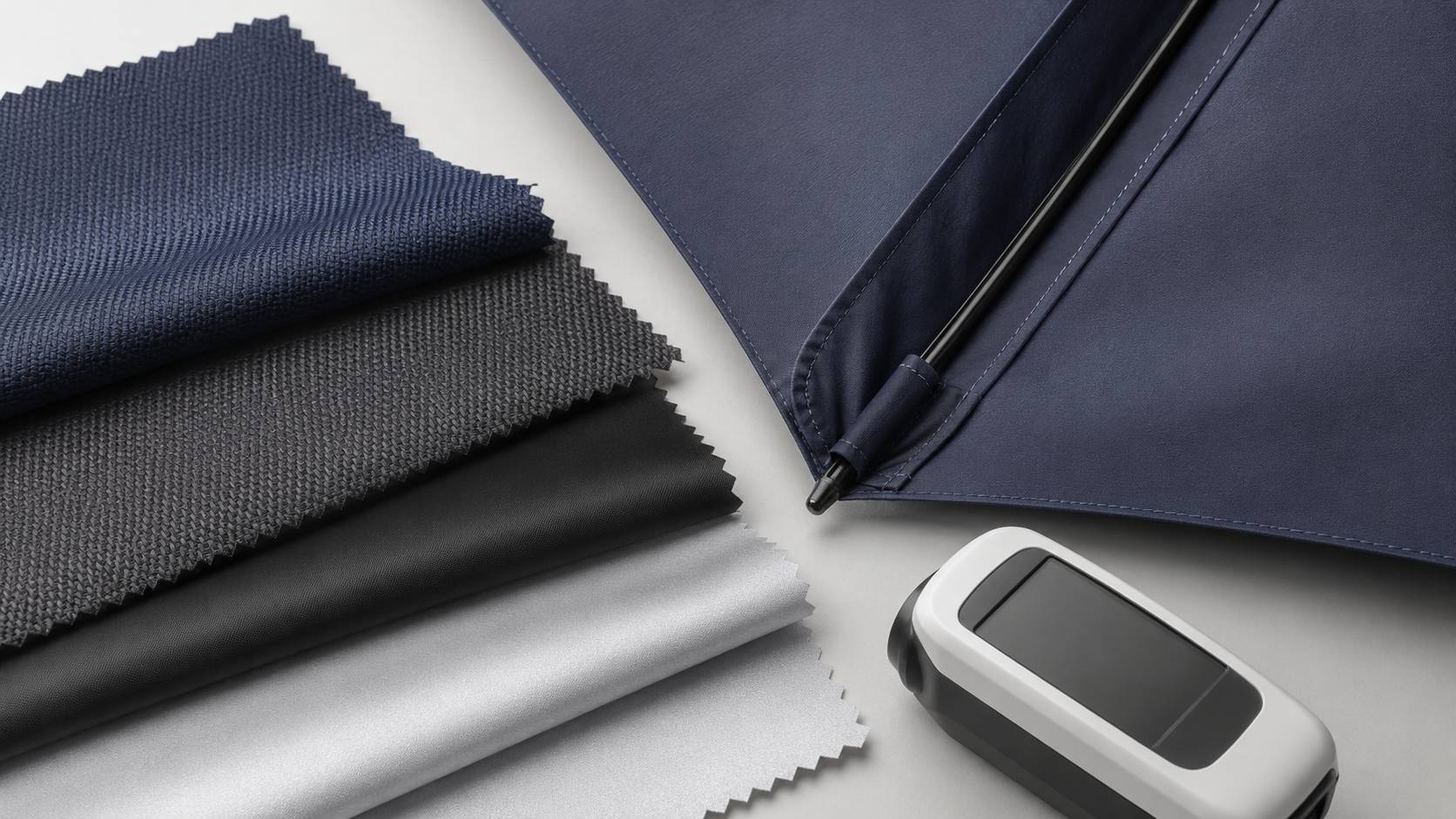
This is the step most likely to be missed in a fast quotation. A factory may have a valid report for one fabric in its library, while the order uses another supplier, yarn density, coating recipe or color. Small specification changes can affect transmission, handle, weight and appearance.
Create a traceable material description for the order. It can include fiber type, fabric construction, weight or density, finished color, coating type, coating side and supplier article code. Add the required test result to the approved specification rather than leaving it only in an email attachment. For repeat orders, require written approval before the factory substitutes the fabric or coating source.
For larger programs, it may be sensible to test a production-representative sample or final canopy material. The correct approach depends on order value, risk level and destination requirements, but the principle stays the same: the claim on the product should be connected to the material actually shipped.
4. Evaluate fabric and coating as a complete system
A tightly constructed fabric, a UV-absorbing treatment, a black coating or a silver coating can all contribute to sun-shading performance. None should be judged by appearance alone. Darker colors may reduce transmission in some constructions, but weave density, fiber, finish and coating consistency also matter. A pale UV protection umbrella with an effective tested treatment may perform better than an untested dark canopy.
Inspect the underside for pinholes, uneven coating, tackiness, cracking and color transfer. Check high-stress locations such as tips, seams, the top notch and rib pockets. Open the sample under strong light to look for inconsistent areas, but treat this as a workmanship check rather than a UPF test.
Comfort matters too. Some coatings create a darker shade and may reduce perceived heat beneath the canopy, but the complete design influences the user experience. Canopy diameter, curvature, air movement, handle length and total weight should be reviewed together. Water repellency should be specified separately because UV protection does not automatically mean reliable rain performance.
5. Check the frame, operation and repeated-use durability
A good canopy is only useful if the umbrella opens smoothly and survives normal handling. Review the shaft material, rib material, number of ribs, runner, springs, joints, tips and handle attachment. For automatic models, check button force, opening speed, closing effort and any anti-rebound mechanism. For very compact models, confirm that the weight saving does not make the frame unsuitable for the intended positioning.
Sample evaluation should include repeated opening and closing, gentle inversion recovery where the design allows it, water-spray observation, drying behavior, seam inspection and coating abrasion at contact points. Buyers can agree on a cycle test or inspection method appropriate to their price point. Avoid calling a compact sun umbrella “windproof” unless there is a clearly defined and substantiated test behind that statement.
Packaging should not damage the canopy coating. A sleeve that is too tight can create scuffing, while a poorly folded canopy can develop permanent creases. Review the folded sample after storage, not only immediately after assembly.
6. Confirm how customization affects the approved sample
Private-label programs often change canopy color, printing, handle shape, sleeve, hangtag and retail packaging. Each change should be considered part of the UV protection umbrella specification. Large printed areas, metallic inks or added layers may change the feel and appearance of a panel. Color differences can also change how the product is perceived in sunlight.
Before bulk production, approve a pre-production sample with the final fabric, color, logo size, print position, handle, hardware finish, sleeve and packaging. Provide artwork in a production-ready vector format and record color references clearly. If the UPF statement will appear on a hangtag or package, the wording must match the evidence available for the final construction.
A reliable umbrella supplier should be able to separate optional features from verified performance. For example, custom printing and black coating can be offered as options, while a specific UPF claim is used only when a corresponding test report covers the selected material.
7. Seal the sample and build a simple inspection plan
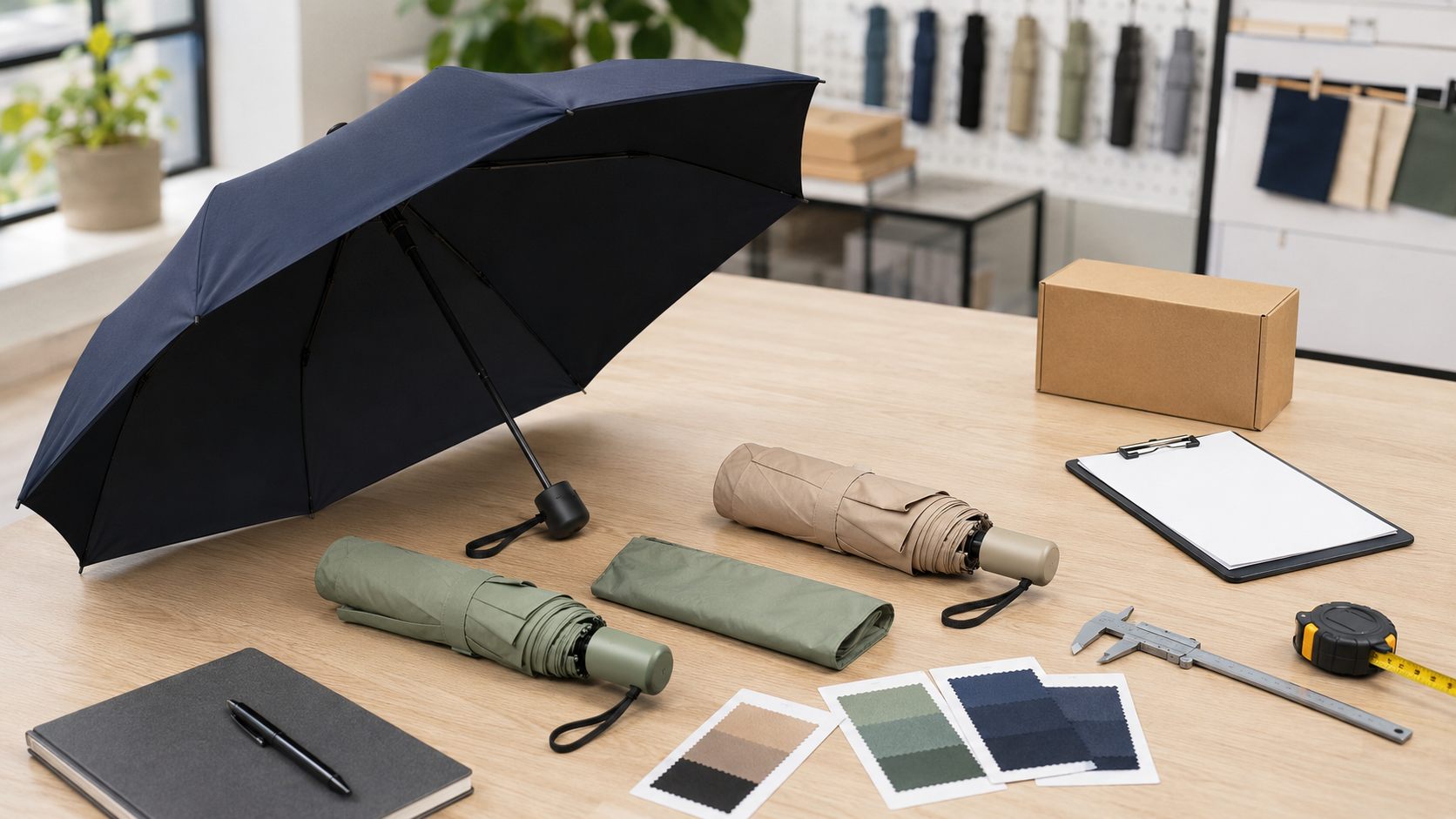
Once the pre-production sample is approved, identify it as the sealed reference for the order. The purchase specification should record the dimensions, weight tolerance, fabric and coating, frame components, color, print, packaging and any test documents required before shipment.
A practical final inspection can verify quantity, workmanship, measurements, opening and closing function, logo placement, color consistency, packaging and a sample of repeated-use checks. If the contract requires laboratory testing, define who selects the sample, when it is tested and what happens if the result does not meet the agreed requirement.
This process is especially important for a UV protection umbrella because buyers cannot confirm UV transmission by eyesight. A sealed sample and traceable bill of materials reduce the chance that a later substitution changes the product without being noticed.
Sun protection should be layered
An umbrella creates useful portable shade, but it does not block UV reflected from surrounding surfaces or reaching the user from open sides. The American Academy of Dermatology recommends a broader approach that includes seeking shade, wearing protective clothing and using broad-spectrum, water-resistant sunscreen on exposed skin. Product copy should present the umbrella as one part of sun protection rather than a complete medical safeguard.
This distinction makes marketing more credible. It also helps distributors avoid absolute claims such as “100% UV proof” or “complete protection,” which are difficult to justify and may conflict with local advertising rules.
Conclusion
The best wholesale sun umbrella is not simply the darkest canopy or the thickest coating. It is the product whose intended use, material identity, test evidence, frame durability, customization and labeling all point to the same approved specification.
Before placing an order, ask the supplier to show exactly which fabric was tested, how the production material will be controlled and which details will appear on the finished label. That discipline turns a broad UV claim into a product that can be compared, inspected and sold with greater confidence.
VESTA supports importers, distributors and private-label brands with folding umbrella development, canopy treatments, custom colors, printing and packaging. Share your target market, quantity, preferred umbrella structure and required test standard to receive a more accurate proposal.
Frequently Asked Questions
What is the difference between UPF and SPF?
UPF is used to describe UV protection provided by textiles, while SPF is used for sunscreen. A UPF claim for umbrella fabric should be supported by a relevant test report.
Does a black coating automatically mean UPF 50+?
No. A black coating may contribute to UV blocking and shade, but the finished fabric should be tested before a specific UPF value is advertised.
Can one test report cover every umbrella color?
Not automatically. The report must be reviewed against the exact fabric, color, coating and construction ordered. Ask the laboratory or compliance adviser whether the tested range is representative.
Should the finished umbrella be tested or only the fabric?
Textile UPF methods generally evaluate material, but buyers may choose production-representative material or a finished-canopy sample depending on the claim, order risk and destination requirements.
What information should I send for a wholesale quotation?
Provide the umbrella type, canopy size, folded length, target weight, fabric and coating preference, color, logo artwork, packaging, quantity, destination market and required test or labeling standard.
Looking for a custom UV protection umbrella? Contact VESTA with your target market, quantity, structure, color, logo and test requirements.