

7 Questions Buyers Should Ask Before Ordering Large Garden Umbrellas
Ordering a large garden umbrella is not simply a matter of choosing the biggest canopy in a catalogue. The canopy, frame, opening system, base and installation surface work as one shade system. If one part is poorly matched, the result may look attractive in a quotation but become difficult to use, expensive to ship or unsafe on site.
For retailers, importers, hospitality projects and outdoor-living brands, the best buying decision starts with better questions. The following seven checks help buyers compare quotations on equal terms and turn a visual product choice into a clear technical specification.
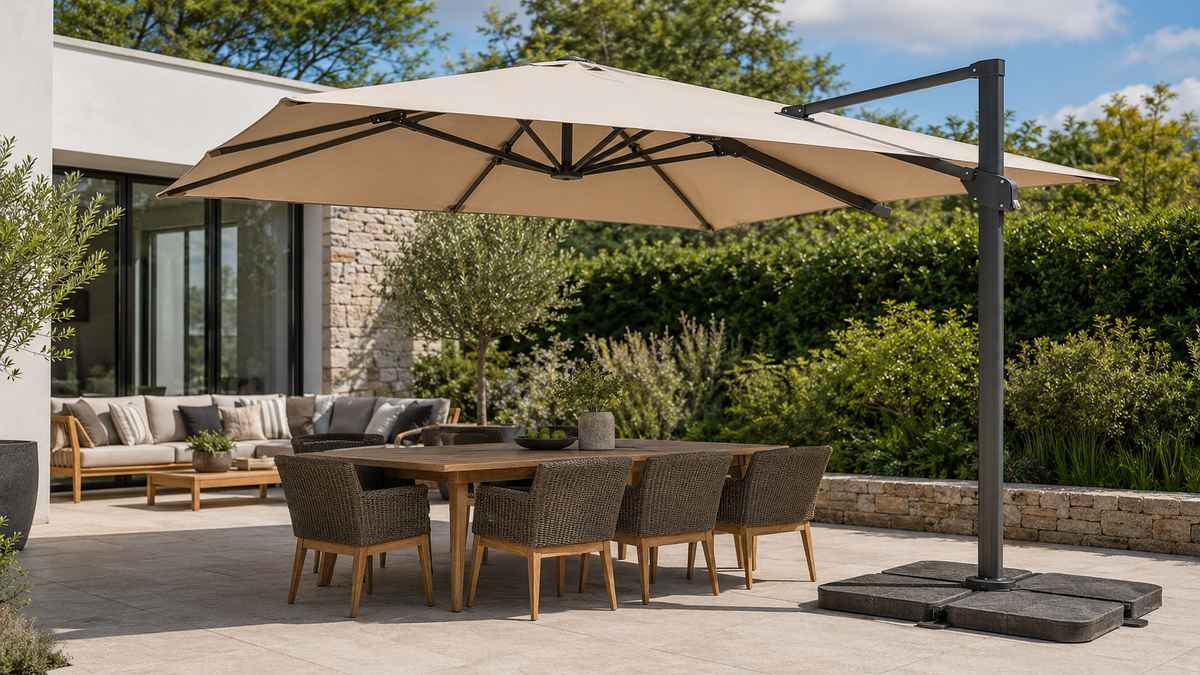
A complete shade solution includes the canopy, frame, operating mechanism and correctly matched base.
1. What space and activity need to be shaded?
Begin with the furniture layout rather than the umbrella size. A round dining table, a long restaurant table, a poolside sofa and a row of sun loungers create different shade patterns. Measure the area people actually occupy, then allow room for chairs to move, doors to open and guests to walk around the installation.
Canopy shape matters as much as nominal width. Round canopies suit circular tables and compact seating groups. Square models align neatly with modular furniture, while rectangular canopies are useful over long tables or paired loungers. Also consider the direction of the afternoon sun: a tilt or rotation function may provide more useful coverage than simply adding canopy width.
Ask the supplier for the open dimensions, total height, clearance height and base footprint. For a cantilever model, request the sweep area needed when the canopy rotates. These figures help confirm that the umbrella can open and move without hitting a wall, tree, awning or adjacent table.
2. Is a center-pole or cantilever structure more practical?
A center-pole umbrella is usually the most direct solution for a table with an umbrella hole, a café setting or a compact terrace. Its load is carried close to the center of the canopy, and the product is generally simpler to assemble and move. The trade-off is an obstruction in the middle of the shaded area.
A cantilever garden umbrella places the supporting mast outside the usable space. This is valuable for lounge furniture, spas, pools and larger dining zones. However, the offset load requires a stronger frame, more base area and careful placement. Buyers should compare the complete installed footprint, not the canopy alone.
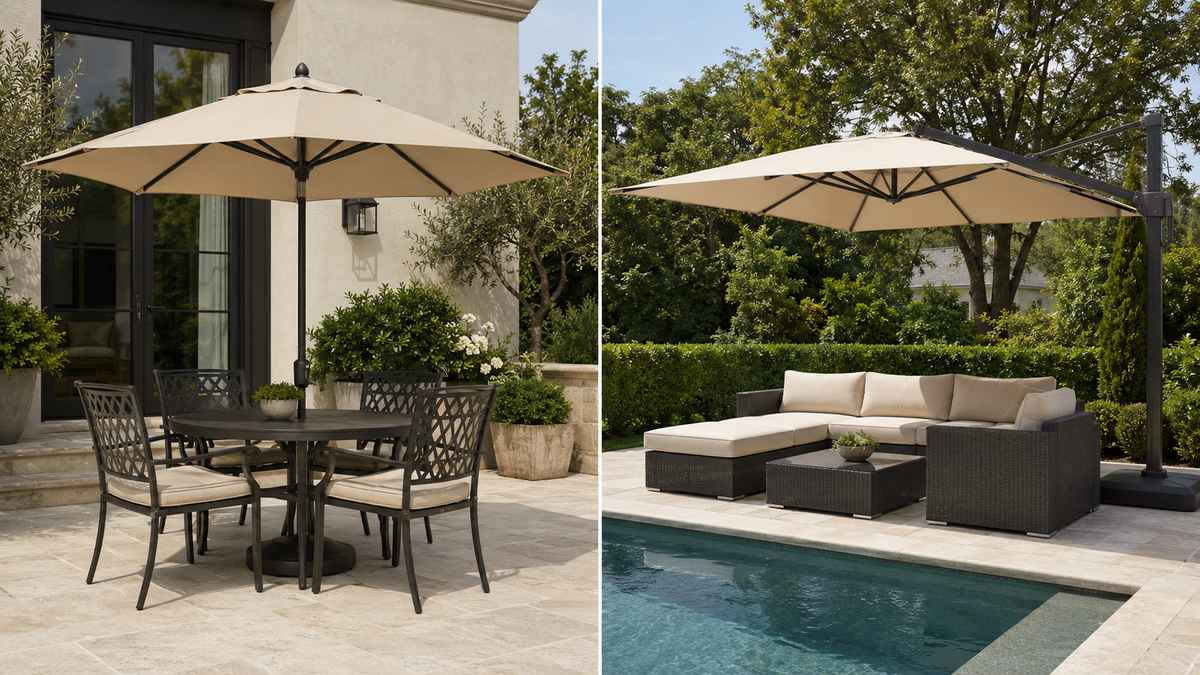
Center-pole models work naturally with dining tables; cantilever models keep the shaded area free of a central mast.
For either structure, request the frame material, pole profile, wall thickness, rib dimensions and surface finish. Aluminum reduces weight and offers good corrosion resistance. Powder-coated steel can provide an economical, strong structure when the coating and joints are properly protected. Wood creates a warm hospitality look but normally needs more maintenance.
Small components deserve attention too. Inspect hinge plates, rib connectors, bolts, cable routing and plastic parts. Ask whether a damaged rib, crank handle or canopy can be replaced without discarding the whole product.
3. What can the supplier prove about the canopy fabric?
Fabric weight is useful, but it is not a complete performance certificate. Two fabrics with the same grams per square metre can behave differently because of yarn quality, weave, dyeing method and coating. A serious comparison should include composition, fabric weight, coating, colourfastness, water-repellency and the test method behind any UV claim.
Polyester is widely used because it offers flexible printing, many colour options and competitive pricing. Solution-dyed acrylic is often selected for premium projects where long-term colour retention is a priority. Neither material name guarantees a result on its own, so ask for a test report that matches the exact fabric and colour being quoted.
Check practical construction details as well: reinforced corners, double stitching, secure rib pockets, a replaceable canopy and a vent that allows warm air to escape. A vent may reduce some uplift, but it does not make an open umbrella windproof. Water-repellent fabric can handle brief light rain, yet a garden umbrella should not be presented as permanent all-weather roofing.
4. Which base or anchoring method belongs to this model?
The base is part of the product specification, not an optional afterthought. The correct solution depends on canopy area, pole position, frame design, installation surface and the conditions of use. There is no single base weight that is safe for every large garden umbrella.
Common options include fillable bases, cross stands with separate weight plates, mobile granite or concrete bases, and fixed ground flanges. A restaurant terrace may value a movable base, while a permanent resort installation may be better suited to a correctly engineered fixed mount. Cantilever umbrellas usually need a larger counterweight footprint than comparable center-pole models.
Clarify whether the quotation includes the cross stand, plastic shell, internal weights or stone plates. Heavy plates are often excluded from export shipments and sourced locally, which changes both landed cost and installation planning.
Safety note: request the manufacturer's installation instructions and operating limits for the exact configuration. Close and secure the umbrella when it is unattended, during gusty conditions or before a storm. For projects requiring documented wind performance, ask for the test method, test setup and rated conditions rather than accepting the word “windproof.” U.S. CPSC meeting records identify ASTM F3512-21 as a test method used to evaluate wind safety and durability of market umbrellas.
5. How easy is the umbrella to operate every day?
A mechanism that feels acceptable during one showroom demonstration may become frustrating after hundreds of openings. Match the operating system to the canopy size and the people who will use it. Push-up systems are simple; pulley systems suit traditional designs; crank systems reduce effort on larger canopies.
For adjustable models, test the full sequence: opening, closing, tilting, rotating and locking. The handle should be reachable, the movement should feel controlled, and the canopy should not collide with the mast. Ask whether the supplier performs cycle testing on the mechanism and what parts are available as spares.
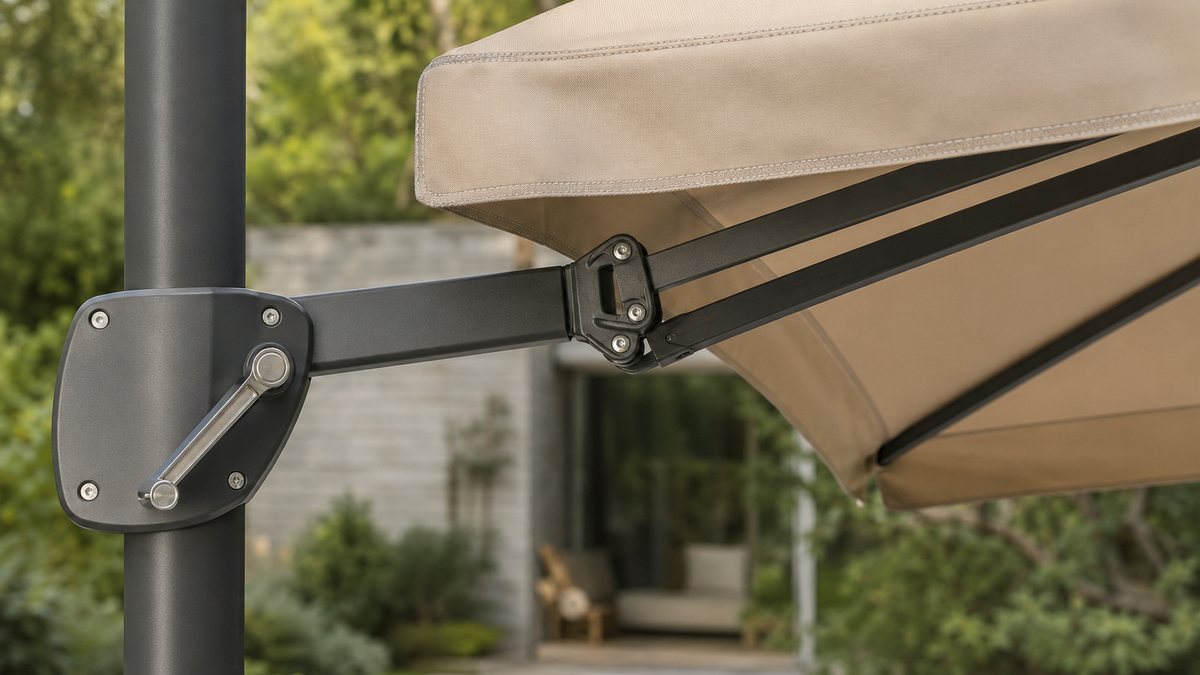
Crank housings,pivots, rib joints and canopy stitching are useful inspection points before a bulk order.
6. Is the product designed for export logistics and after-sales service?
A competitive unit price can be cancelled out by inefficient packaging or avoidable damage. Before confirming a wholesale order, request the carton dimensions, gross weight, loading quantity and a clear packing diagram. Long frame sections need protection at both ends, while cranks, finials and hardware should be secured so they cannot rub against the canopy in transit.
Ask how many cartons make up one complete set and whether the base travels separately. This prevents split deliveries and incomplete retail packages. For private-label orders, review the assembly manual, carton marks, barcode location and language requirements before mass production.
After-sales planning is equally important. A small stock of canopies, ribs, handles, bolts and connector parts can extend product life and reduce warranty cost. Confirm how parts are identified, packed and ordered, especially for hotel, restaurant and rental projects where downtime matters.
7. What customization and compliance evidence will be supplied?
Customization should be documented before the purchase order. Confirm canopy colour, frame colour, logo method, print position, valance, packaging, labels and accessories with drawings or an approved sample. Ask whether the minimum order quantity applies per model, per colour or per print design.
Compliance requirements vary by destination and sales channel. Tell the supplier where and how the product will be sold, then list the documents you need. Depending on the market, this may include material test reports, UV-performance evidence, colourfastness results, packaging information or restricted-substance documentation.
Do not rely on a badge placed on a sales image. The report should identify the tested sample, relevant standard, result, laboratory and date. If the specification changes, confirm whether the existing report still covers the production material.
Quick selection guide
|
Application |
Practical starting point |
Critical check |
|
Café dining table |
Center-pole umbrella |
Table-hole fit, clearance and movable base |
|
Poolside lounge |
Cantilever umbrella |
Base footprint, rotation sweep and corrosion resistance |
|
Balcony or wall edge |
Half-round or compact model |
Wind exposure, mounting permission and folded storage |
|
Resort or restaurant project |
Commercial center-pole or engineered cantilever model |
Test evidence, replaceable parts and operating procedure |
Information to include in your RFQ
· Application, destination market and installation surface
· Required canopy size, shape, colour and estimated shade area
· Preferred frame material, finish and operating mechanism
· Fabric composition, weight, coating and required test evidence
· Base or anchoring method, including locally sourced weights
· Logo artwork, printing method, packaging and labelling
· Order quantity, target price, sample requirement and delivery date
· Carton data, loading quantity, spare parts and warranty terms
Frequently asked questions
What size large garden umbrella should I order?
There is no universal size. Measure the occupied furniture area, allow space for movement, and consider the sun angle at the time the space is used most. Ask for open dimensions, clearance height and base footprint before confirming the model.
Is a cantilever umbrella always better than a center-pole umbrella?
No. Cantilever designs free the space under the canopy, but they require more counterweight and floor area. Center-pole models are often simpler and more efficient for dining tables or compact commercial layouts.
Can a garden umbrella remain open in windy weather?
Only within the manufacturer's stated operating conditions and with the specified base or anchoring system. A vented canopy and heavy base do not remove wind risk. Close the umbrella when it is unattended, when gusts increase or when storms are expected.
Which is better for wholesale orders: polyester or acrylic?
Polyester provides broad colour and printing options at a competitive cost. Solution-dyed acrylic is often chosen when premium colour retention is a priority. Compare verified performance, expected service environment and replacement cost rather than selecting by material name alone.
What should I approve before mass production?
Approve the dimensions, materials, colour, logo placement, mechanism, base configuration, packaging, labels, assembly instructions and required reports. A signed specification sheet and approved sample reduce misunderstandings during production.
Turn the quotation into a complete shade system
The most reliable buying process compares complete configurations, not isolated headline features. A well-specified large garden umbrella should fit the space, operate smoothly, use verified materials, arrive with the right base and remain serviceable after the first season.
Explore VESTA's garden umbrella collection or send an inquiry with your target size, market, quantity and branding requirements. Our team can help organize the product specification and quotation for your project.